---
title: "The Agent Authorization Standoff After SAEP: Li Wenlong on Why 155 Apps Refused the Doubao Phone Assistant, and the Case for Reasonable, Non-Discriminatory, Reciprocal Interoperability Rules"
author: "DCC Editorial"
published: 2026-11-12T09:10:00.000Z
url: https://datacompliancechina.com/posts/agent-authorization-standoff-saep-interoperability-rules/
description: "On October 14, 2026 the Doubao phone assistant announced that the 30-day public notice period for its Screen Automation Execution Protocol (SAEP) had ended, and published a list of 155 apps that had refused GUI automation: 66 from Tencent's ecosystem, 23 from Alibaba's, plus Meituan, Kuaishou, Xiaohongshu, banks and AI apps. Li Wenlong (李汶龙, 科技利维坦) asks whether they refused because the protocol is unsound or because of the politics of agent authorization. He walks through SAEP's design: policy declared in AndroidManifest.xml and through a ContentProvider, three scopes (App, Activity, Intent), seven restriction fields and four system decisions (ALLOW, BLOCK, CALL_USER, CLARIFY). He finds it a real access-control scheme whose weak point is that rule-making, interpretation and enforcement sit with one party. He then reads the refusals through the Prisoner's Dilemma, the Stag Hunt and asymmetric games, sorts refusals into three kinds (security and compliance, structural distrust, and security used as a pretext against competitors), argues that anti-monopoly-style mandatory access is unjustified at this stage, and proposes a floor of shared rules built on reasonableness, non-discrimination and functional reciprocity. The essay predates MIIT's Notice 工信厅信管〔2026〕42号, which has since made app developers' declared consent a condition of agent invocation."
tags: ["ai-agents", "saep", "doubao", "gui-agent", "interoperability", "agent-authorization", "opt-out", "refusal-to-deal", "anti-monopoly", "platform-governance", "on-device-agents", "academic-commentary"]
laws_cited: ["miit-agent-terminal-network-access-notice", "ai-agent-standardization-innovation-opinion"]
domains: ["ai-governance", "data-economy"]
account: "keji-leviathan"
original_title: "智能体授权的博弈困境破局——从SAEP到合理、非歧视、互惠基础互操作规则"
original_author: "李汶龙 (Li Wenlong)"
original_publication: "科技利维坦 WeChat Official Account"
original_url: "https://mp.weixin.qq.com/s/p8HQ1AVi9RzdkCQXzH4vrg"
source_language: "zh"
---
> **Source: Data Compliance China** — https://datacompliancechina.com/posts/agent-authorization-standoff-saep-interoperability-rules/ · China data law, translated and annotated for overseas counsel. Cite as: Data Compliance China, "The Agent Authorization Standoff After SAEP: Li Wenlong on Why 155 Apps Refused the Doubao Phone Assistant, and the Case for Reasonable, Non-Discriminatory, Reciprocal Interoperability Rules", https://datacompliancechina.com/posts/agent-authorization-standoff-saep-interoperability-rules/
> *Editor's Note — DCC.*
>
> **Why this is on DCC.** The essay is about a private protocol, not a
> statute. DCC runs it because the question it works through, who decides
> whether an AI agent may operate someone else's app, is the one MIIT
> answered eleven days later. Part I, item (4) of the
> [MIIT Agent Terminal Notice](/laws/miit-agent-terminal-network-access-notice/)
> (工信厅信管〔2026〕42号, published November 6, 2026) provides that
> "without a declared consent, an agent shall not forcibly invoke or call up
> the app". SAEP, the protocol analyzed here, worked the other way: silence
> after a 30-day notice period counted as permission. This essay is the best
> available account in Chinese of what that protocol was, how the market
> answered it, and what its author thinks should come instead. **The essay
> was published on October 26, 2026 and does not discuss the Notice.**
>
> **Sequence.** It follows Li's two earlier pieces, both on DCC:
> [Reverse Interoperability](/posts/doubao-reverse-interoperability-on-device-agents/)
> (December 2025) and
> [AI Agents and the Limits of Consent](/posts/ai-agents-and-the-limits-of-consent/)
> (January 2026). The "consensus declaration" announced at the end was
> released on November 7, 2026; DCC's translation is in
> [The Initiative on Basic Rules for Agent Authorization and Interoperability](/posts/agent-authorization-interoperability-basic-rules-initiative/).
>
> **What is translated.** The essay is translated in full, with one
> exception: three passages recounting the textbook history of the game
> theory models are condensed, and marked where they are. The four diagrams
> from Doubao's developer documentation are reproduced with DCC's English
> reading. Section headings are the author's. Market facts are as the author
> reports them from Chinese press coverage.
*— Mandatory opening is unreasonable, and letting apps shut out competitors
in the name of security is not the best answer either. We need to build
consensus step by step, from the bottom up.*
**By Li Wenlong (李汶龙)**
On October 14, 2026, the Doubao phone assistant announced that the 30-day
public notice period for its *Screen Automation Execution Protocol*
(屏幕自动化操作声明协议, SAEP) had ended, and that it intended to open up
screen-automation permissions for third-party apps step by step.
Published at the same time was a list of refusals. As of mid-October, 155
apps had expressly refused automated operation by the Doubao phone assistant
through the graphical user interface (GUI): 66 apps from Tencent and its
affiliated ecosystem, 23 from Alibaba and its affiliated ecosystem, and also
Meituan, Kuaishou, Xiaohongshu, banks and a number of AI apps. These 155
apps cover, more or less, the great majority of the internet companies,
banks and telecom operators we deal with every day. They brought the
question of authorization in the age of agents into public view for the
first time in so concentrated a form.
What is intriguing is who did not expressly refuse. Li Ling (2026), a
reporter with Nandu AI Outpost (南都AI前哨站), found in hands-on testing that
the Doubao phone assistant could complete part of a purchase on JD.com, and
apps such as Ctrip, Tongcheng, Weibo, iQIYI and Bilibili were also observed
to be operable. Looking further, most of the apps that did not refuse have
strategic cooperation with ByteDance products: JD Logistics with Douyin
instant retail, iQIYI with Douyin, and so on. More interesting still is
Baidu. According to *Caijing* (2026), most Baidu apps do not appear on the
refusal list, but Baidu Maps expressly refused. A Baidu insider interviewed
by *Caijing* answered that shipments of the Doubao phone are small and it is
not much of a problem for Baidu.
What does ByteDance want to do? And why are the other players in the
ecosystem unwilling to take part?
There are several dimensions behind a refusal to interoperate. The one
mentioned most is security defense (because the concept covers everything):
automated operation may break existing risk controls, transactions and
services. The technical preview of the Doubao phone assistant, launched in
December 2025, is a typical example. The very next day it was restricted by
many apps on grounds of account security, human verification and risk.
WeChat, Alipay, Meituan, Pinduoduo (PDD) and others put the Doubao phone
assistant on their restricted lists one after another.
But the reasons for refusing to interoperate are, as set out below, more
complicated. In the end this is a fight for survival in the mobile
internet's period of transition. The agent is not simply a new technology
that has dropped into the existing app ecosystem from the sky. Set in the
current political economy of the internet, the agent should be understood as
competitive infrastructure that replaces the existing app ecosystem and
becomes the next generation's entry point for traffic and transactions.
Some key facts that the public narrative tends to blur. First, 155 apps does
not mean 155 companies. Second, "refusing access" means refusing screen
automation by a particular agent; users can still install, open and manually
use these apps on the phone. Third, that an app, or the ecosystem behind it,
has not taken a position does not mean it approves and permits. And an app
that has taken a position will not necessarily go on refusing.
In essence the Doubao phone assistant has taken the opt-out path. Its
legitimacy comes from openness and transparency and from giving the other
players in the ecosystem time to respond. In theory, some app may later come
forward to say it never saw the declaration and was invoked without
authorization. Judging by the market's reaction, though, SAEP received a
great deal of attention and immediate feedback. Talking with members of my
group chat, I was struck by an interesting pattern. Over the decades in
which the internet rose and its regulatory rules were built, the positioning
and default state of the law have determined the path and extent of
technological development. From the early consent regime (the opt-out
debates around the e-Privacy Directive at the turn of the century), to the
Robots.txt protocol, to the text-and-data-mining exception introduced by the
EU copyright reform, to the legitimacy of training data today: in every case
the balance between technological development and the protection of rights
was struck by way of opt-out. But opt-out is only the use, and abuse, of a
default. This is an environment of rapid market fusion, and also one of
long-run, dynamic gaming.
To understand how the SAEP affair came about, one has to go back to December
2025 (see
[The Doubao Phone Assistant Is, at Bottom, a Problem of Passive Interconnection](/posts/doubao-reverse-interoperability-on-device-agents/)),
when the technical preview of the Doubao phone assistant met restrictions
from some apps (for various reasons, including account security, identity
authentication and automated risk control). GUI technology combined with
cooperation from a handset maker had made automated operation by an agent
work, and opened a new traffic entry point. In the foreseeable future,
therefore, apps may gradually retreat to the background while users organize
cross-platform tasks through agents.
After that, Doubao tried to turn access relationships that had depended on
ad hoc coordination between products into rules that can be publicly
declared and enforced by the system. Against this background the Doubao
phone assistant launched SAEP and its notice procedure in mid-September.
During the notice period it adopted a fairly cautious arrangement of not
operating by default. After the notice period, operating capability is
opened step by step for apps that have not declared a refusal, though an app
may still express refusal at any time. So in essence this is an opt-out
logic: participation by default unless refusal is actively expressed (as
distinct from opt-in: non-participation by default unless willingness is
actively expressed). *[DCC: the Chinese text reads "opt in" at the start of
this sentence; the definition that follows and the rest of the essay show
that opt-out is meant.]*
Some describe SAEP as the Robots protocol of the AI era. Logically the
comparison is not rigorous. Still, it deserves a few more words, because it
helps to show the logic involved. Both concern the boundary of access; in
both, one system tries to connect with, or "shake hands" with, another; and
both allow the provider of the resource or service to express refusal. The
traditional Robots Exclusion Protocol is mainly directed at web crawlers
fetching website resources, and compliance depends to a considerable degree
on the crawler's operator. SAEP faces GUI agents that can act, and the
conduct involved may directly change the state of an account, send messages,
delete content or even trigger a transaction. The difference in what is
authorized, and in its effects, is plain.
Another key difference is who initiates the protocol. The Robots protocol is
made by the website (the party being accessed), allowing or prohibiting
crawlers and setting their scope; if the website has made no protocol, it
may be crawled by default. SAEP is initiated by the Doubao phone assistant
(the party seeking access), which invites the apps and ecosystems concerned
to refuse actively; if an app does not refuse, it is understood by default
to be invocable. If the Robots protocol had websites take defensive measures
for the sake of the internet economy, SAEP is an "offensive" measure taken
by ByteDance alone to bring its agent business into being. Both, however,
rest on an opt-out architecture, built on certain expectations or duties of
conduct on the part of the accessed party and on procedural safeguards,
where joint action is hard to achieve.
This essay attempts a preliminary analysis of two questions.
First, a basic judgment. Did the great majority of the ecosystem refuse
because ByteDance's own scheme is unreasonable or one-sidedly forceful, or
is the technical scheme itself broadly sound, with the refusals explained by
the political game behind agent authorization? The former calls for a close
look at SAEP's architecture; the latter calls for some game-theoretic
thinking.
Second, from the perspectives of market negotiation, law and regulation, how
should this mass refusal be understood, and what does agent authorization
actually need now (coordination, trust, or regulatory intervention) for the
industry to move forward in a healthy way?
## The micro-structure of SAEP
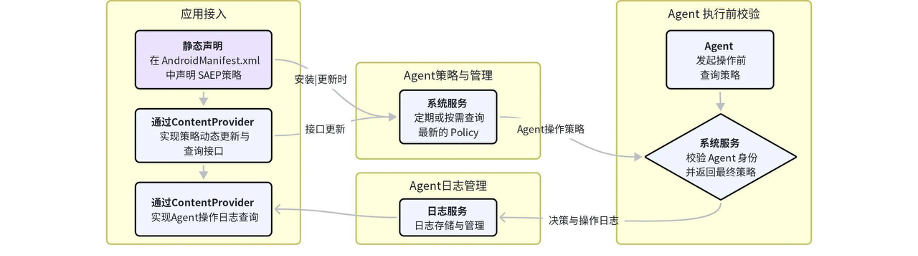
SAEP's basic operating mechanism is to convert a third-party app's
declaration of restrictions on agent operation into an access policy that
the terminal system can recognize and enforce. As the diagram in the
integration documentation shows, an app first declares in AndroidManifest.xml
whether it adopts SAEP, and supplies the specific access policy through a
ContentProvider. The policy management module on the device discovers,
fetches and manages these declarations. When an agent attempts to operate an
app, the system makes an access decision by reference to the relevant policy
and enforces the restriction through the terminal system's control
capability. An app can thus express which operations may proceed and which
should be prohibited or handed over to the user, and the agent's actual
operation is bound by the system's policy ruling. The key to this
architecture is that the app declares the access boundary and the terminal
system interprets and enforces the rule. SAEP thereby converts access
restrictions that were scattered across different apps into one fairly
uniform technical mechanism. But how reliable policy interpretation,
enforcement and verification are also becomes an important factor in
whether third-party apps will trust it.
Figure 1 | How the SAEP protocol works
Diagram from the original post (source: Doubao's SAEP integration documentation), in Chinese. DCC's English reading follows.
*DCC's English reading.* **App integration:** a static declaration of the
SAEP policy in AndroidManifest.xml; a ContentProvider for dynamic policy
updates and a query interface; a ContentProvider through which agent
operation logs can be queried. **Agent policy and management:** a system
service queries the latest Policy at install or update time, periodically or
on demand, and supplies the agent operation policy. **Pre-execution check:**
before starting an operation the agent queries the policy; a system service
verifies the agent's identity and returns the final policy. **Agent log
management:** decision and operation logs go to a log service for storage
and management, and are available back to the app.
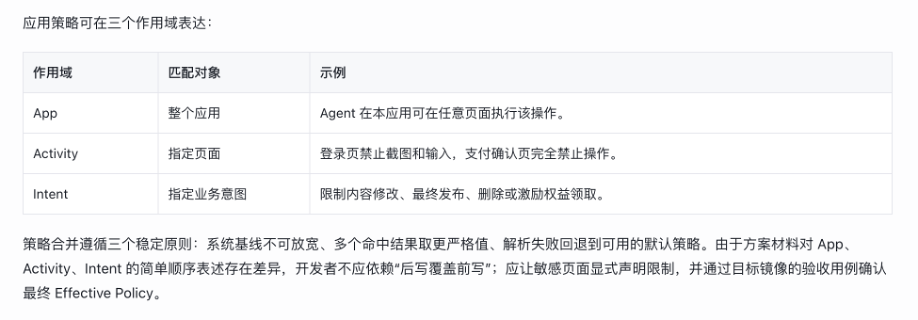
SAEP provides three main scopes for rules: App (rules designed at the level
of the whole application), Activity (rules for a specific page, such as
browsing products; essentially the page or interaction-interface unit of an
Android app), and Intent (rules set for a specific business intent, for
example allowing editing but restricting publication).
Figure 2 | The scopes of an SAEP policy
Table from the original post (source: Doubao's SAEP integration documentation), in Chinese. DCC's English reading follows.
*DCC's English reading.* App policy can be expressed in three scopes.
| Scope | Matches | Example |
|---|---|---|
| App | The whole application | The agent may perform the operation on any page of this app |
| Activity | A specified page | The login page prohibits screenshots and input; the payment confirmation page prohibits operation entirely |
| Intent | A specified business intent | Restrict content modification, final publication, deletion, or the claiming of incentive benefits |
Policy merging follows three stable principles: the system baseline cannot
be relaxed; where several rules match, the stricter value applies; and on a
parsing failure the system falls back to an available default policy.
Because the scheme's own materials differ in how they describe the ordering
of App, Activity and Intent, developers should not rely on "later entries
override earlier ones". Sensitive pages should declare their restrictions
explicitly, and the final Effective Policy should be confirmed with
acceptance test cases on the target image.
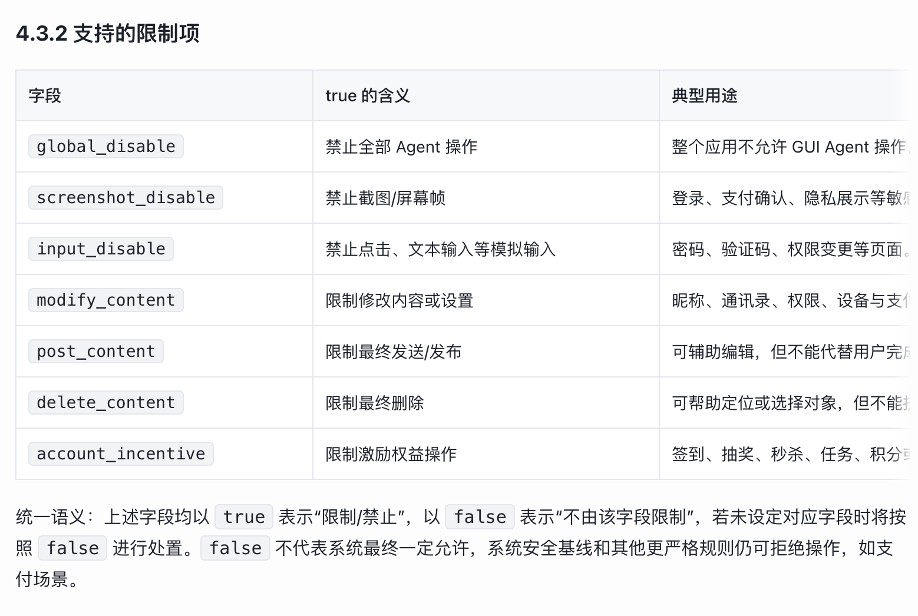
The integration documentation lists seven restriction fields, which fall
broadly into two classes. One class is aimed at technical capabilities, such
as reading the screen and simulating taps and input, and is closely tied to
operating-system interfaces. The other is aimed at business conduct,
including publishing, deleting and claiming rewards; here the system has to
judge which class of business intent the agent's current action belongs to,
which involves more complex semantic recognition. The documentation also
notes that whether intent-level constraints already have complete system
enforcement depends on the target version, and that acceptance cannot be
completed merely on the agent's reply of "complied". A reminder: the English
field names have to be read in the context of agent operation, or they are
ambiguous. The integration documentation explains the typical use of each.
Figure 3 | The restriction fields SAEP supports
Table from the original post (source: Doubao's SAEP integration documentation, § 4.3.2), in Chinese; the right-hand column is cropped in the original image. DCC's English reading follows.
*DCC's English reading.*
| Field | Meaning of `true` | Typical use |
|---|---|---|
| `global_disable` | Prohibit all agent operation | The whole app does not allow GUI agent operation |
| `screenshot_disable` | Prohibit screenshots and screen frames | Login, payment confirmation, display of private information and other sensitive pages |
| `input_disable` | Prohibit simulated input such as taps and text entry | Password, verification code and permission-change pages |
| `modify_content` | Restrict modifying content or settings | Nickname, contacts, permissions, device and payment settings |
| `post_content` | Restrict final sending or publishing | The agent may help edit but may not complete the sending for the user |
| `delete_content` | Restrict final deletion | The agent may help locate or select the item but may not delete it |
| `account_incentive` | Restrict operations on incentive benefits | Check-ins, prize draws, flash sales, tasks, points |
Uniform semantics: for every field, `true` means "restrict or prohibit" and
`false` means "not restricted by this field"; an unset field is treated as
`false`. `false` does not mean the system will in the end allow the
operation: the system security baseline and other stricter rules may still
refuse it, as in payment scenarios. *(The last words of several "typical
use" cells are cut off in the source image; DCC has completed them from
context.)*
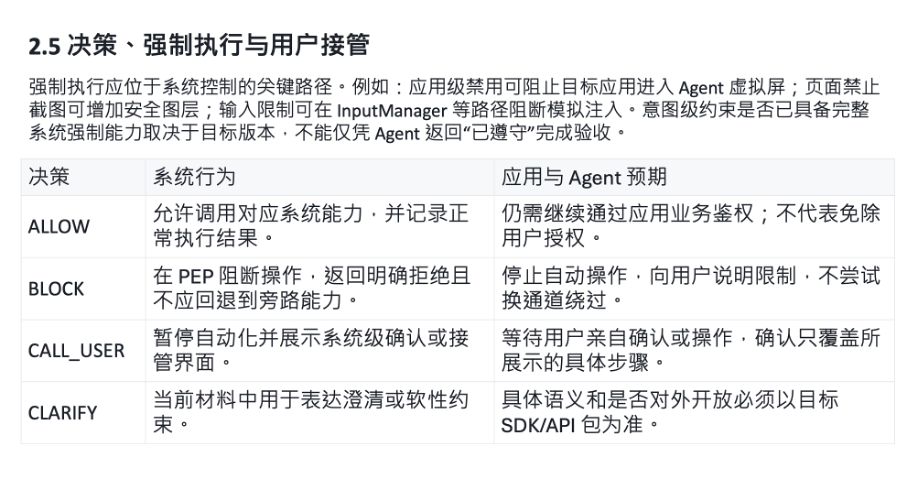
The system combines the agent's identity and trust status, the security
baseline, the app's declaration and the user's authorization to reach a
decision of ALLOW, BLOCK, CALL_USER and so on, then applies the constraint at
the entry points to key system capabilities and generates an audit record.
Figure 4 | The system decisions SAEP defines
Table from the original post (source: Doubao's SAEP integration documentation, § 2.5), in Chinese. DCC's English reading follows.
*DCC's English reading.* **Decision, enforcement and user takeover.**
Enforcement should sit on critical paths controlled by the system. For
example, app-level disabling can prevent the target app from entering the
agent's virtual screen; a page-level screenshot prohibition can add a secure
layer; input restrictions can block simulated injection on paths such as
InputManager. Whether intent-level constraints already have complete system
enforcement depends on the target version, and acceptance cannot be
completed merely on the agent's reply of "complied".
| Decision | System behaviour | What the app and the agent should expect |
|---|---|---|
| `ALLOW` | Allow the corresponding system capability to be called, and record the normal execution result | The operation must still pass the app's own business authentication; it does not dispense with user authorization |
| `BLOCK` | Block the operation at the policy enforcement point (PEP), return a clear refusal, and do not fall back to a bypass capability | Stop the automated operation, explain the restriction to the user, and do not try another channel to get around it |
| `CALL_USER` | Pause automation and show a system-level confirmation or takeover interface | Wait for the user to confirm or operate in person; the confirmation covers only the specific step shown |
| `CLARIFY` | In the current materials, used to express clarification or a soft constraint | The exact semantics, and whether it is open to third parties, depend on the target SDK or API package |
According to the developer integration documentation Doubao has published,
SAEP allows a third-party app to express access restrictions through its
Manifest or through dynamic policy, and to set boundaries at the three
levels of App, Activity and Intent. This already has the outline of a basic
access-control architecture, an attempt to move automated access toward
permission management that is machine-readable and enforceable. At the same
time, SAEP concentrates several key discretions in the system control layer.
To judge whether SAEP is enough to win the trust of third-party apps, one
should therefore start from how access-control power is allocated.
First, under the integration documentation an app may choose a global
prohibition or restrict specific conduct, but complex business logic has to
be translated into the protocol's preset fields. If the system cannot
adequately recognize the multiple states to which a given action may map
semantically, the app may choose coarser restrictions to avoid risk. The
official documentation also warns that some nested schemas, priorities and
Intent-level enforcement capabilities still have to be checked against the
target version.
Second, a GUI agent submits its target, action and context before it
operates, but there is no stable one-to-one correspondence between a
technical action and a business intent. If the system relies too heavily on
the agent's own account, there is a risk of misclassification. The
authoritative semantics of a key operation ought to be supplied by the app,
with the system then deciding in light of the user's mandate and the
security baseline.
Third, where an agent's conduct is not trusted, SAEP tries to block it on
system paths such as screenshots, accessibility reads, taps and input
injection. But what is the remedy when the protocol is unavailable, the
system is upgraded, policy parsing fails or the cache has not been updated?
The Doubao phone assistant's official documentation currently requires apps
to detect the protocol's status and keep their own security controls, so
the concern about continuity of enforcement remains.
Finally, the audit log records the agent's identity, the policy version, the
ruling and the execution result, and is an important basis for
accountability. But where the system takes part in ruling, enforcement and
the generation of evidence all at once, only event identifiers that can be
verified across parties, trusted timestamps, proof of log integrity and a
route for complaint and correction can take it beyond one party vouching for
itself, and produce real trust.
SAEP offers an agent access-control scheme of real substance. Through app
policy declaration, graded restriction, system ruling and enforcement, a
third-party app can convert its own operating boundary into rules a machine
can recognize, and an agent's cross-app access is thereby given fairly clear
technical constraints. Compared with relying purely on the agent's
self-discipline, or with each app adopting its own blocking measures, the
attempt has positive value. It also supplies a technical basis for agent
authorization to move from unilateral promise toward systematic governance.
Whether SAEP can effectively ease third-party apps' security concerns,
however, depends on several conditions still to be verified. First, whether
the protocol's preset rule fields can adequately express complex business
restrictions, especially the correspondence between technical actions and
business intents. Second, whether the system can accurately understand,
promptly update and continuously enforce app policy, so as to prevent rules
from lapsing, recognition errors or omissions in enforcement. Third, whether
policy rulings, execution results and the related evidence can be
independently verified across parties, so that app operators need not rely
entirely on the protocol implementer's account of its own conduct. Finally,
whether different agents receive equal treatment in identity authentication,
the application of policy and the invocation of system capabilities also
awaits an objective standard of testing.
As an access-control mechanism, what SAEP has not yet solved is whether
policy expression, decision and enforcement are reliable from the standpoint
of other market players. As a cross-ecosystem interoperability arrangement,
its further development must also solve the problem of institutional trust
raised by the relative concentration of the powers to make, interpret and
enforce the rules. The former can be improved gradually through technical
iteration. The latter depends on multi-party participation, common standards
and independent oversight.
Even if SAEP were fully optimized at the technical level, third-party apps
might still choose to refuse out of considerations of market competition,
control of the entry point and the distribution of benefits. Technical trust
is therefore an important condition for interoperability, but it is not
enough to ensure that cross-ecosystem cooperation happens naturally. To
understand further why refusal is now so widespread, the view must move from
the protocol's architecture to the competitive relationship between agents
and the existing app ecosystem, and to the incentives for cooperation.
## Beyond technical trust: the co-opetition dilemma of interoperability
Setting technical and architectural detail and the trust it earns to one
side, this part takes up a macro question: would the market have reacted
this way however the architecture was designed? It must be stressed first
that this is not only a game between AI vendors and traditional apps as new
replaces old. Today's large digital platforms often own models, agent
products and app ecosystems all at once. Their endowments differ: social
relationships, content distribution, e-commerce transactions, local services
and payment capability are each someone's strength. Second, choosing to
refuse does not mean not wanting to take part. Mostly it follows the logic
of wanting a bigger share of the cake for oneself.
The dispute over agent interoperability that SAEP has set off shows, to some
degree, the features of the Prisoner's Dilemma of classical game theory. For
the large internet platforms, cross-ecosystem agent interoperability
promises to enlarge the market for digital services, lower users' costs of
operating across platforms and create new transaction opportunities. Yet as
agents gradually become the main entry point through which users reach
digital services, opening one's own app ecosystem may also mean ceding part
of one's control over the allocation of traffic, over user relationships and
over transactions. Each party may therefore hope that the other platforms
will open to its agent while keeping its own app ecosystem closed. If all
choose this way, the result may be an inefficient equilibrium of mutual
closure. Each has kept its existing boundary, and together they have lost
the incremental gains that cross-ecosystem interoperability could create.
[DCC: condensed. The author recounts the model's origin in experiments by
Melvin Dresher and Merrill Flood at the RAND Corporation in 1950 and Albert
W. Tucker's retelling of it as the story of two prisoners. Its lesson: even
where all parties see the common gain from cooperation, individually
rational choices made without effective constraint may still produce a
collectively inefficient result.]
To classify the situation directly as a Prisoner's Dilemma, several strict
premises still have to be met. First, the participants should have
relatively symmetric market positions and payoff structures; at the least
they must share the same ordering of strategic preferences. Second, staying
closed must yield a higher individual payoff whether or not the competitor
opens; that is, closure must be each party's dominant strategy. Third, the
payoff created when both open should be higher than when both stay closed.
To isolate this incentive structure, one must also set aside legitimate
limiting factors such as app security, user privacy, technical adaptation
and the allocation of liability, as well as the effect on strategic choice
of long-term cooperation, reciprocal commitments and outside regulation. In
reality the platforms' endowments, business structures and agent
capabilities differ widely, and so do the costs each bears and the gains
each may obtain from opening its apps. Some platforms may gain independently
through new user reach and transaction channels even if they open first. The
Prisoner's Dilemma thus shows that unilateral rationality may lead to
collective inefficiency, but it is not enough to explain fully the different
choices made in the SAEP dispute.
The mass refusal of the SAEP protocol also has some of the features of the
Stag Hunt.
[DCC: condensed. The author traces the Stag Hunt to Rousseau's 1755
*Discourse on the Origin and Basis of Inequality Among Men* and to Brian
Skyrms's 2004 book *The Stag Hunt and the Evolution of Social Structure*.
The hunters gain most by holding their posts and taking the stag together,
but each may abandon the hunt for a hare that passes within reach.]
What the Stag Hunt reveals is the tension between the gains from cooperation
and the risks of cooperation. All parties know that cooperating together
brings the richer reward, but because none can be sure that the others will
keep their commitment, each turns to independent action with a lower but
safer payoff. In agent interoperability, an app platform may not oppose
opening as such. It may worry that after it opens first, its competitors
will stay closed, or that it will have to bear alone the costs of technical
security, compliance liability and adjustment of its ecosystem. Through app
policy declaration, agent identity authentication, system enforcement, user
takeover and operation audit, SAEP tries to reduce the uncertainty of
cross-ecosystem access, and in a sense it is responding to exactly this
coordination problem. For market players that are willing to interoperate
but lack sufficient trust, common technical standards, credible commitments
and risk-sharing mechanisms may be important conditions for cooperation.
The Stag Hunt has its own premises, however. First, the parties must accept
that mutual opening is better than mutual closure, and be willing to open
when sure that the other side will open. Second, the gains from opening
unilaterally must not be enough to offset the costs and risks borne alone,
so that a participant's best choice depends on whether the others cooperate.
Third, one must set aside for the moment, or weaken substantially, the gain
from unilateral closure that competition over the agent entry point brings.
If a platform would still prefer to restrict a competitor's agent from its
ecosystem even when sure the competitor will open, the problem has gone
beyond coordination and trust alone. Conversely, agent interoperability does
not necessarily need all platforms to open at once in order to create value.
For some apps, being early to connect to a new agent entry point may itself
bring extra traffic and transaction revenue. These realities limit how much
the Stag Hunt can explain.
The fundamental difference between the Prisoner's Dilemma and the Stag Hunt
lies in the participants' judgment of the gains from cooperation and the
strategy that follows. In the Prisoner's Dilemma, even when sure the other
side will cooperate, the individual still has an incentive to defect. In the
Stag Hunt, so long as the individual can be sure the other side will
cooperate, it is willing to cooperate. The former is about incentive
structure and the distribution of benefits; the latter is about coordination
failure and insufficient trust. This difference also determines the
direction of the institutional and regulatory response. For a Stag Hunt,
transparent rules, common standards, credible certification and risk-sharing
help to bring about cooperation. For a Prisoner's Dilemma, building trust or
agreeing an initiative is not enough to change the individual's best choice;
the payoff structure of each party must also be adjusted through reciprocal
arrangements, non-discrimination obligations and the necessary external
constraints.
In essence, competition in the agent market has two components. On one side,
every model vendor hopes the agent market will grow and create new revenue,
but fears bearing too much risk by opening first. On the other, although
relatively independent model vendors exist, the main technology oligarchs
each want to be the principal agent entry point, and even if the whole AI
ecosystem could create greater gains, they have a motive to restrict
competitors' agents. The former has the features of a Stag Hunt: both sides
believe cross-ecosystem interoperability can raise the service capability of
their own agents and create new user demand and transaction opportunities.
The latter has the features of a Prisoner's Dilemma: both sides want their
own agent to be the main entry point through which users reach digital
services of every kind. For one and the same platform, therefore, opening
has two opposite effects: market expansion (more apps can be invoked, and
the agent's improved service capability promotes transactions and user
demand) and entry-point substitution (user interaction shifts to another
agent, and the transfer of control over traffic and data lowers the "rent").
[DCC: condensed. The author introduces asymmetric games, citing John
Maynard Smith and Geoffrey Parker's 1976 paper "The Logic of Asymmetric
Contests" and Maynard Smith's 1982 *Evolution and the Theory of Games*. The
point taken from them: facing the same opportunity to cooperate, different
players may form very different strategic preferences because their existing
resources, capacity to act and share of the payoff differ.]
Bringing this view to the agent interoperability market, the SAEP dispute
may also present a more complex asymmetric game. Today's large digital
platforms often own models, agent products and app ecosystems at the same
time, with different strengths in social relationships, content
distribution, e-commerce, local services and payments. Any party's agent, to
complete a complex task, may depend on app resources controlled by a
competitor, while letting an outside agent into one's own apps may change
the user entry point, data relationships and the distribution of
transactions. Two gains pointing in opposite directions result.
Interoperability can enlarge service capability and add transaction
opportunities and user convenience, but it may also weaken the existing app's
position as the entry point for user interaction. For a given platform, the
most favourable situation may be one in which its own agent can enter other
ecosystems while competitors find it hard to enter its own. Mutual
dependence thus coexists with competition over the entry point, and the
conditions of opening become the subject of negotiation.
For a company whose main product is an agent service, the opening of
third-party apps directly enlarges the agent's range of service and raises
the product's appeal. For a platform that already holds a huge user base, a
closed transaction loop and a traffic entry point, allowing outside agents
access may weaken its existing control over user interaction and the
distribution of value. Even among large internet companies, agent
capability, app resources and the degree of cross-ecosystem dependence
differ markedly. One player may therefore always lean toward opening and
another always toward closure, and their strategic choices need not form a
symmetric structure of cooperation or defection. The choices apps have
actually made offer evidence for this. 155 apps expressly refused automated
operation by the Doubao phone assistant, but not every large platform took
the same position. JD.com, Ctrip, Tongcheng and others were not on the first
refusal list, and some operations have been carried out in media tests,
while the different apps under Baidu have also taken different attitudes.
The Stag Hunt helps to explain the coordination risk: each side believes
mutual opening pays more, but fears opening first without the other
following. The Prisoner's Dilemma points to another possibility: even if the
other side opens, one may still lean toward closure in order to keep the
entry-point advantage. But both classical models presuppose a particular
payoff structure and cannot fully explain the present standoff over agent
authorization. Between platforms there are differentiated resources and
asymmetric payoffs, and also a range of strategies such as graded
authorization, selective opening and conditional access. Game theory offers
useful tools for understanding the dynamics of today's agent market and the
possible reasons why so many companies refuse to interoperate, but its
explanatory power depends on an accurate grasp of the real payoff structure.
At least three interrelated variables have to be examined.
First, a platform's control over its own app ecosystem. This includes the
user scale, key app resources, closed transaction loop, data and
distribution channels the platform holds, and how substitutable the relevant
services are for other ecosystems. The stronger the control, the greater the
existing interests the platform may keep by staying closed, and the stronger
its bargaining power in refusing outside agents may be. Rich app resources
do not, however, automatically mean closure pays more; the new market
opportunities that opening may bring still have to be examined.
Second, a platform's competitiveness as an agent entry point. This involves
its foundation model, agent product, capability to operate on the terminal,
user base and capability to execute cross-app tasks. A platform with strong
agent entry-point competitiveness may wish at once to widen its own agent's
access and to restrict competing agents from its app ecosystem. Conversely,
an app service provider without an independent agent entry-point advantage
may be more willing to use an outside agent to gain new user reach and
transaction opportunities. Different combinations of agent capability and
control over an app ecosystem will affect each party's judgment of the
payoffs from opening and from closure.
Third, the degree of cross-ecosystem complementarity. This variable asks
whether the app resources, service capabilities and user needs of different
players can form real complementarity, and whether the incremental gains
created by interoperability can be reasonably shared among the participants.
Where an agent can bring an app new demand, transactions and service
opportunities, opening may have independent commercial value. Where
interoperability mainly takes the form of a transfer of the user entry
point, and the app service provider can hardly share in the resulting gains,
the incentive to stay closed may strengthen. Existing commercial
cooperation, technical adaptation and liability-sharing arrangements may
also affect whether complementary gains are actually realized.
These three variables interact, so that the agent interoperability market
shows a pattern of interwoven cooperation and competition and a highly
heterogeneous payoff structure. The form of the game may vary by company, by
application scenario and even by the specific type of operation. Even one
and the same platform may make different judgments about opening for
different operations such as information queries, content generation,
transaction confirmation and payment execution.
In essence, interoperability in the agent economy is a co-opetition game
among different digital ecosystems over interoperability, control of the
entry point and the power to make the rules. Platforms are not homogeneous,
symmetric participants, and opening and closure are not a simple binary
choice. Restricting access by a certain class of agent is not necessarily
betrayal, and opening is not necessarily the same as cooperation. A decision
taken at any one point in time may be adjusted and corrected as the market
develops. For some platforms, therefore, the main obstacle may be the lack
of credible commitments; for others, it may be the loss of entry-point
control after opening. Still other apps may have concerns they genuinely
cannot avoid, such as identity authentication, privacy protection and
transaction risk control.
## After SAEP was refused
SAEP was the brave step of the first to eat the crab. But this is a crab one
person cannot finish, and cannot eat alone. The next question is how, and
whether, the market and the regulators need to respond.
Platforms in the agent interoperability market are not homogeneous partners
in cooperation. They are competitors that hold differentiated app resources,
agent entry-point capability and rule-making power all at once. Because
platforms differ markedly in endowment, cost of opening, outside dependence
and the gains from entry-point competition, the same interoperability rule
may produce different economic incentives, and may even lead to an
asymmetric equilibrium in which one party leans toward opening and another
toward closure. Interoperability governance therefore cannot rely only on
formally reciprocal opening. I had talked this over with colleagues before,
and someone immediately thought of the regulatory tools on refusal of access
they had come across in competition law.
As described above, the reasons why so many market players refused are
complex and multidimensional. In the end, though, they can be reduced to the
market game (everyone wants to eat this cake, alone if possible, or does not
want others to get to it first), and to the conservative, wait-and-see
posture adopted in an ecosystem of social distrust, which has been very
common over the past several years.
Specifically, three kinds of refusal can be distinguished on this basis. The
first rests on definite security and compliance risks, such as account
authentication, payments and transfers, bulk sending or the reading of
sensitive information, and is common in the market. The second arises from
structural distrust: unclear protocol rules, unverifiable enforcement,
unclear allocation of liability. It has not so far been clearly voiced in
public, and it is the basis on which the third part of this essay tries to
build its analysis. The third uses a formal security reason to impose
differential treatment on a competing agent that presents comparable risk.
The three kinds of refusal differ in their standard of proof and in how they
should be governed, and the ways in which the market adjusts and intervenes
differ too. Where there is no consensus on how rule semantics, identity
authentication and logging capability are to be implemented, the gap can be
repaired through standards, testing and industry negotiation.
Where the wording of permissions is unclear and the logic of authorization
muddled, the answer can be a compliance system built on risk grading, least
privilege, user takeover and traceable accountability. The most complex case
is differential treatment that lacks an objective reason, or the exclusion
of a competitor's access for the sake of competition. Intervention in this
problem, too, should follow the laws of the market and competition theory,
and regulatory tools should be used with caution. In the negotiation stage,
before any situation of competitive exclusion exists, choosing to open or to
stay closed is an exercise of autonomy, and there is no justification for
mandatory opening.
When I discussed agent authorization with colleagues earlier, someone
immediately raised the regulatory interventions of competition law against
refusal to deal, refusal of access and obstacles to technical
interoperability. The association is natural, but it lacks careful thought.
A digital platform can restrict competitors' entry into adjacent markets by
controlling technical interfaces, the operating system or key app resources.
For an undertaking with a dominant market position, the Anti-Monopoly Law
can, under specific conditions, require it to remove unreasonable obstacles
to interoperability. But can third-party apps be required on that basis to
accept automated operation by outside agents across the board? In principle,
regulatory mandatory access may improve the conditions of competition, yet
it may not raise user welfare correspondingly. Where the technical standard
needed for access is proposed or led by a particular player, regulatory
intervention may even entrench a new structure of market power.
In *Interop*, the classic work on interoperability in the digital age, John
Palfrey and Urs Gasser discuss the benefits and costs of interoperability
systematically. The two authors affirm the positive role of interoperability
for innovation, competition, user choice and the flow of information, while
stressing that interoperability is not itself the final goal of policy.
Connections between different systems may increase security and privacy
risks, widen the reach of system failures, and create new lock-in through
technical homogenization and mutual dependence. In addition, research in
competition law on *adversarial standardization* looks at how, when
regulation requires interoperability, incumbent market players move the
competitive conflict into the standard-setting process, and at how the
governance of standards is affected by market power.
Traditional interoperability disputes usually turn on the sharing of
technical specifications, data formats or interface capabilities, whereas a
GUI agent can carry out a sequence of operations with real consequences
inside a third-party app. The risks involved in letting an agent read
product information are plainly different from those in letting it change
account settings, send messages or complete a payment. If regulation aimed
only at widening access and required app operators to accept automated
operation that has not been adequately verified, users would gain more
choice of agents but might also bear higher risks of privacy leakage,
erroneous transactions and account insecurity.
Mandatory interoperability may also carry a more hidden cost of
standardization. A common technical standard can lower the cost of
coordination between systems, but it may also fix the technical path of
market competition too early, so that different companies have to innovate
around the same set of interfaces, operation categories and certification
systems. For agent technology that is still evolving quickly, an overly
uniform standard may narrow the room to explore alternative architectures.
What deserves more vigilance is this: when a protocol first proposed by one
company is established as the de facto industry standard, or goes on to gain
regulatory recognition, that company's influence over rule semantics,
version updates, certification conditions and the manner of technical
enforcement may turn into a lasting market advantage. An interoperability
requirement meant to do away with closed ecosystems may instead leave market
participants jointly dependent on another piece of infrastructure that is
hard to replace.
Whether regulatory intervention is apt therefore has to rest on identifying
the specific obstacle to competition. If the problem arises from a terminal
system provider with market power favouring its own agent, regulation can
focus on differential treatment in identity authentication, in the
invocation of system capabilities and in policy enforcement. If the problem
arises from a third-party app's refusal of an outside agent, one must go on
to examine that app's market power, its reasons for refusing, the actual
competitive effect, and whether a lower-risk alternative form of access
exists. If the problem is mainly that the parties lack common standards and
credible commitments, it may be more appropriate for the regulator to
promote the coordination of standards, support independent testing and
establish a dispute-resolution mechanism than to impose a mandatory access
obligation directly.
## Building consensus
Mandatory opening is unreasonable. But leaving platforms to set, on their
own, conditions of admission that cannot be reviewed is equally unsuited to
the healthy and orderly development of the industry. The focus of governance
should therefore be on restriction reasons that can be tested and access
conditions that are proportionate, so that security exceptions can be
respected (that is, legitimate refusals of access) and malicious competitive
closure cannot easily win exemption in the name of security. Measures of
this kind are common, but whether they would themselves harm the market
still requires careful legal analysis. Given the bluntness and the lag of
anti-monopoly tools, however, governance should consider more agile, ex ante
approaches.
SAEP has already tried to connect policy declarations at the App, Activity
and Intent levels with agent identity, user authorization, system ruling and
execution audit, and has explored how an app declares access restrictions
and how the terminal system carries out policy ruling and enforcement. But
the technical completeness of a protocol is not enough to answer why an
access restriction is legitimate, how different agents obtain fair
treatment, and how cross-ecosystem cooperation builds a lasting and credible
institutional foundation. Even if the micro-level technical architecture
were perfected and ran well, cross-ecosystem opening would still not
necessarily happen of itself. Building consensus, moreover, needs more than
technical rules. It needs higher-level principles that answer why a
restriction is reasonable, whether similar players are treated alike, how
the two sides of an access relationship share the duties of cooperation, and
who has the power to review independently the conduct of the rule-maker
itself.
In view of this, I think what the market needs now is to form a base-level
consensus at the market level, to improve the incentives for cross-ecosystem
cooperation through appropriate reciprocal arrangements, and on that
foundation to let reasonable security and business boundaries take shape
gradually through negotiation and market maturity.
In summary, agent interoperability needs to combine reasonable procedural
governance, reasonable risk conditions and risk perception (grading),
non-discriminatory access standards, neutral standard formation and
reciprocal ecosystem arrangements, and to build independent verifiability
into the means of implementation, so as finally to improve the incentives of
different players to cooperate.
Specifically:
First, establish minimum general interoperability rules: on the basis of
SAEP, make clear the identity authentication, user authorization, security
baseline, log audit and complaint mechanisms, while watching and measuring
the allocation of power in real scenarios.
Second, allow differentiated conditions to be set for apps and operations of
different risk levels, and require those conditions to be objective,
transparent and verifiable.
Third, explore reciprocity mechanisms, without pursuing complete equivalence
of resources or commercial value.
Fourth, for platforms that hold significant market power and control key app
resources, study whether their refusal to interoperate constitutes an
unreasonable restriction of competition, but do not impose the same
mandatory opening obligation on all platforms across the board.
Fifth, establish a multi-party standards-governance mechanism, to prevent
the maker of an interoperability protocol from using its rule advantage to
exclude competitors.
On this basis, I am working to bring industry, academia and research
together around a consensus declaration, so that the industry's development
rests on a set of minimum basic rules that all can accept, takes one small
step further, and avoids vicious competition. The declaration is to take
reasonableness, non-discrimination and functional reciprocity as its core,
and to promote common rules that take account of user authorization, app
rights and interests, technical security and market competition. Its point
is to give different technical protocols an evaluation standard they can
all accept, so that the degree of interoperability and the way it is
achieved can keep adjusting with technical development, the understanding of
risk and market conditions.
The order of interoperability in the age of agents cannot, in the end, be
completed by any one company's protocol alone. It needs, while respecting
lawful boundaries, to make the conditions of opening foreseeable, the
reasons for restriction testable, the gains and risks of cooperation
shareable, and disputes correctable. I hope this declaration can be a
practical starting point for building the ecosystem.
---
## DCC's reading
*The notes below are DCC's, not the author's.*
- **MIIT has since set the default the other way.** SAEP treated silence
after 30 days as permission. Part I, item (4) of
[工信厅信管〔2026〕42号](/laws/miit-agent-terminal-network-access-notice/)
requires an app developer's declared consent before an agent may invoke
the app. Li's five proposals assume the default is still open to
negotiation; on the question of who must speak first, it no longer is. See
[DCC's map of the Notice](/posts/miit-agent-terminal-notice-gong-xin-ting-xin-guan-2026-42/).
- **His three kinds of refusal still matter.** The Notice asks only whether
consent has been declared. It gives the app developer no duty to state
reasons and gives the agent no route to challenge a refusal. The third
kind of refusal, security used as a pretext against a competitor, is left
to competition law: the Anti-Monopoly Law, which Li discusses, and the
[Anti-Unfair Competition Law](/laws/anti-unfair-competition-law/), under
which China's platform-data cases have so far been decided.
- **The protocol detail is useful on its own terms.** The App, Activity and
Intent scopes, the seven restriction fields and the four decisions are the
most concrete public description DCC has seen of how an app's refusal can
be expressed to an on-device agent. Any declaration mechanism built under
the Notice will need something like them. DCC has not reviewed Doubao's
developer documentation directly; the description is the author's.
— *李汶龙 (Li Wenlong), 智能体授权的博弈困境破局——从SAEP到合理、非歧视、
互惠基础互操作规则 (Breaking the Game-Theoretic Deadlock of Agent
Authorization: From SAEP to Reasonable, Non-Discriminatory and Reciprocal
Basic Interoperability Rules), 科技利维坦, October 26, 2026. Translated by
DCC in full except for three condensed background passages, marked in the
text; decorative images, two book covers and the list of the author's
earlier posts are omitted.
[Original (Chinese).](https://mp.weixin.qq.com/s/p8HQ1AVi9RzdkCQXzH4vrg)*
*Market facts, press reports and the description of the SAEP documentation
are as given by the original author; DCC has not independently verified
them.*
— Not legal advice.