---
title: "Apple's New China AI Declarations, and What They Untangle: Algorithm Filing, Large-Model Filing and Registration, and the Security Assessment"
author: "DCC Editorial"
published: 2026-11-27T10:20:00.000Z
url: https://datacompliancechina.com/posts/apple-app-store-china-ai-declarations-filing-security-assessment/
description: "A full translation. On November 16, 2026, Apple added two China mainland compliance declarations to App Store Connect. One asks whether an app provides AI generation or synthesis services, and if so requires an approved large-model or algorithm filing number, plus an authorization or usage agreement from the technology provider when the AI comes from a third party. The other asks whether the app needs a security assessment, and if so requires proof that the app's security assessment report passed on the MPS-run National Internet Security Management Service Platform, plus a copy of the report. Existing apps must complete the declarations and pass verification by January 31, 2027 to stay on the China storefront. 数据何规 argues that the requirements are not new (Xiaomi, Huawei and OPPO already check the same materials, and the Deep Synthesis Provisions and the Labeling Measures already oblige app stores to verify them), and uses the update to separate four things developers routinely confuse. Algorithm filing is counted per algorithm and covers deep synthesis. The 2018 'two-new' security assessment covers the app's own risk controls and cannot be borrowed from a vendor. The security assessment in large-model filing tests the model's outputs under TC260-003. And a large-model filing differs from a local registration, which is the route for apps that call an already-filed model by API. The author's bottom line: a vendor's filing number plus an authorization may get through Apple's AI declaration, but a triggered security assessment must be the app's own."
tags: ["apple", "app-store", "algorithm-filing", "large-model-filing", "large-model-registration", "security-assessment", "deep-synthesis", "generative-ai", "app-compliance", "anthropomorphic-ai", "end-to-end-encryption"]
laws_cited: ["public-opinion-security-assessment-provisions", "algorithmic-recommendation-provisions", "deep-synthesis-provisions", "genai-services-interim-measures", "ai-content-labeling-measures", "cac-new-tech-filing-system-faq-2026-11", "tc260-genai-basic-security-requirements", "gbt-45654-genai-basic-security-requirements", "ai-anthropomorphic-interaction-measures"]
domains: ["ai-governance", "algorithm-recommendation", "app-compliance"]
account: "data-he-gui"
original_title: "由苹果App新政厘清 AI评估/备案"
original_author: "数据何规"
original_publication: "数据何规 WeChat Official Account"
original_url: "https://mp.weixin.qq.com/s/G-7OU4Eey6Jq0GClSz4pdg"
source_language: "zh"
---
> **Source: Data Compliance China** — https://datacompliancechina.com/posts/apple-app-store-china-ai-declarations-filing-security-assessment/ · China data law, translated and annotated for overseas counsel. Cite as: Data Compliance China, "Apple's New China AI Declarations, and What They Untangle: Algorithm Filing, Large-Model Filing and Registration, and the Security Assessment", https://datacompliancechina.com/posts/apple-app-store-china-ai-declarations-filing-security-assessment/
> *Editor's Note — DCC.*
>
> A practitioner explainer from 数据何规, published on **November 19,
> 2026**, translated in full. Its occasion is Apple's November 16 update to
> App Store Connect, which added two China mainland compliance declarations
> for AI apps. Its substance is a map of four Chinese requirements that
> app developers routinely run together: **algorithm filing** (算法备案),
> **large-model filing** (大模型备案), **large-model registration**
> (大模型登记) with the local cyberspace administration, and the
> **security assessment** (安全评估) under the 2018
> [Public Opinion Security Assessment Provisions](/laws/public-opinion-security-assessment-provisions/).
>
> The filing system and FAQs the author relies on are on DCC's law page,
> [CAC Unified Filing System Notice and FAQs (2026)](/laws/cac-new-tech-filing-system-faq-2026-11/);
> the same author's note on those FAQs is
> [What Is New in the CAC's Filing FAQs](/posts/cac-filing-faq-incremental-points-algorithm-large-model/).
>
> The author's numbered notes are kept as bracketed references and
> translated at the end. Where the original quotes Apple's Chinese-language
> help page, DCC translates the Chinese as quoted rather than substituting
> Apple's English page. The original reproduces several screenshots, mostly
> of statutory text that the article itself quotes; DCC carries the three
> that show what Apple and the Android stores ask for, each with an English
> reading. A request to like and share the post, in the introduction, is
> omitted.
## The article
**On November 16, Apple added two China mainland compliance declarations
to App Store Connect. One asks whether the app provides AI generation or
synthesis services; the other asks whether a security assessment has been
done. Existing apps must complete the declarations and pass verification by
January 31, 2027 at the latest, or be removed from sale.** [1]
I had long wanted to get this straight myself: what is the relationship
between algorithm filing, large-model filing, registration, and on top of
those a security assessment?
For a developer that calls a third-party model, the most practical
question is this: the vendor has already filed, so which of its materials
can I use, and what do I still have to do myself?
Apple's update is a good occasion to work through these from the
beginning. I was convinced no AI could answer this, and it took me and
GPT 6.2 Astra ultra several hours together to sort it out.
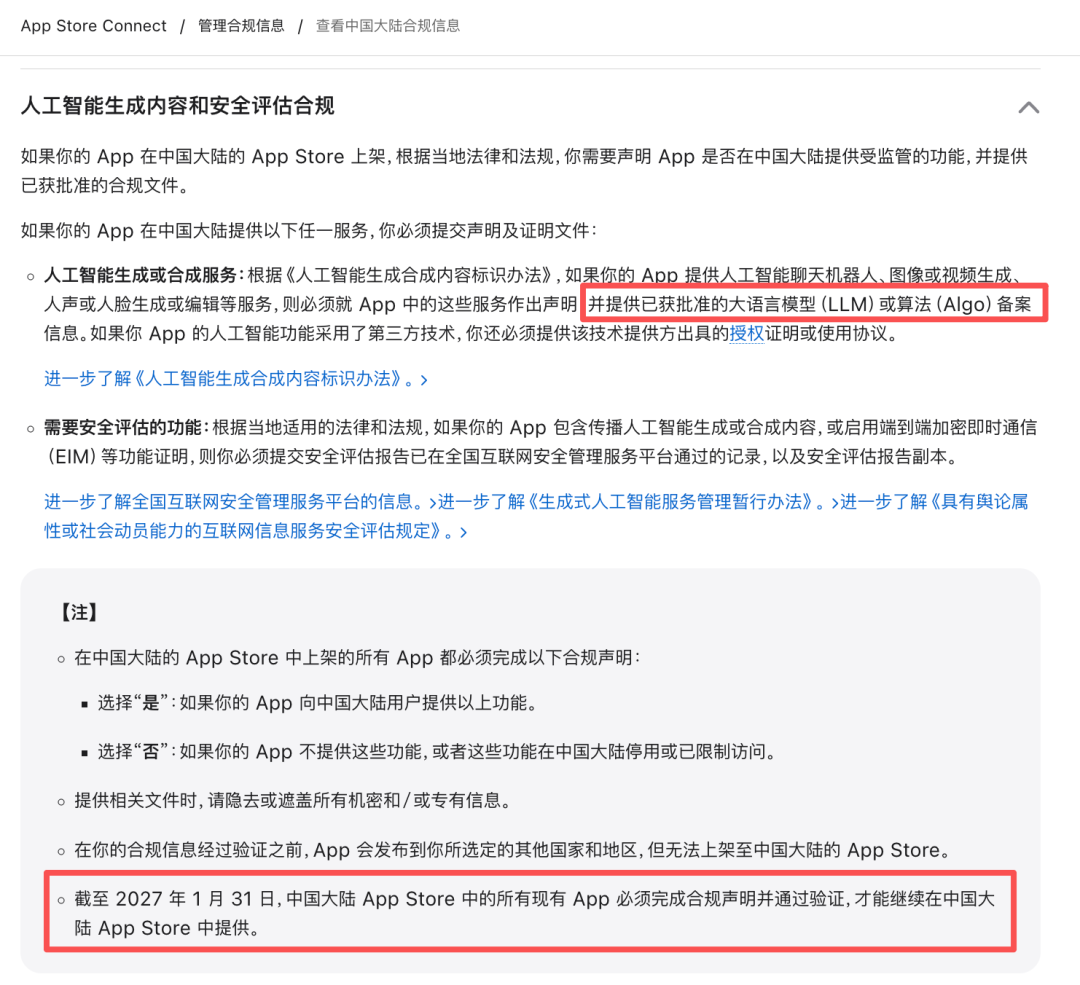
Apple's China mainland compliance page (App Store Connect Help, Chinese version)
Screenshot from the original post, in Chinese, with the author's red boxes. DCC's English reading follows.
*DCC's English reading of the screenshot:* Under "AI-generated content and
security assessment compliance", Apple says that an app on the China
mainland App Store must declare, under local laws and regulations, whether
it offers regulated functions in mainland China and provide approved
compliance documents. **AI generation or synthesis services:** under the
*Measures for the Labeling of AI-Generated and Composed Content*, an app
that offers AI chatbots, image or video generation, or voice or face
generation or editing must declare these services and *provide approved
large language model (LLM) or algorithm (Algo) filing information* (boxed);
if the AI functions use third-party technology, it must also provide an
authorization certificate or usage agreement issued by the technology
provider. **Functions requiring a security assessment:** under applicable
local laws and regulations, if the app includes functions such as
disseminating AI-generated or synthesized content or enabling end-to-end
encrypted instant messaging (EIM), it must submit a record showing that its
security assessment report passed on the National Internet Security
Management Service Platform, plus a copy of the report. The notes say:
every app on the China mainland store must complete the declarations,
answering "yes" if it offers these functions to mainland users and "no" if
it does not or if they are disabled or restricted in mainland China;
confidential or proprietary information should be redacted; until the
compliance information is verified, the app is released in other selected
countries and regions but not on the China mainland App Store; and *by
January 31, 2027, all existing apps on the China mainland App Store must
complete the declarations and pass verification to remain available there*
(boxed).
### I. What does Apple's "new policy" require, and how do you meet it?
#### (1) The policy is not new: Android app stores have long asked for this
Anyone who has listed an AI app in China will recognize these materials.
For generative apps, Xiaomi checks the algorithm filing, the large-model
filing or registration, the materials on labeling generated content, the
security assessment report, and a screenshot showing the report passed on
the public security platform. Huawei likewise checks the generation and
synthesis algorithm filing, the labeling materials, the security assessment
report and the pass screenshot. Where a partner's technology is used, the
algorithm-filing item can be met with the partner's filing materials plus a
cooperation agreement that states the algorithm name or filing number. [2]
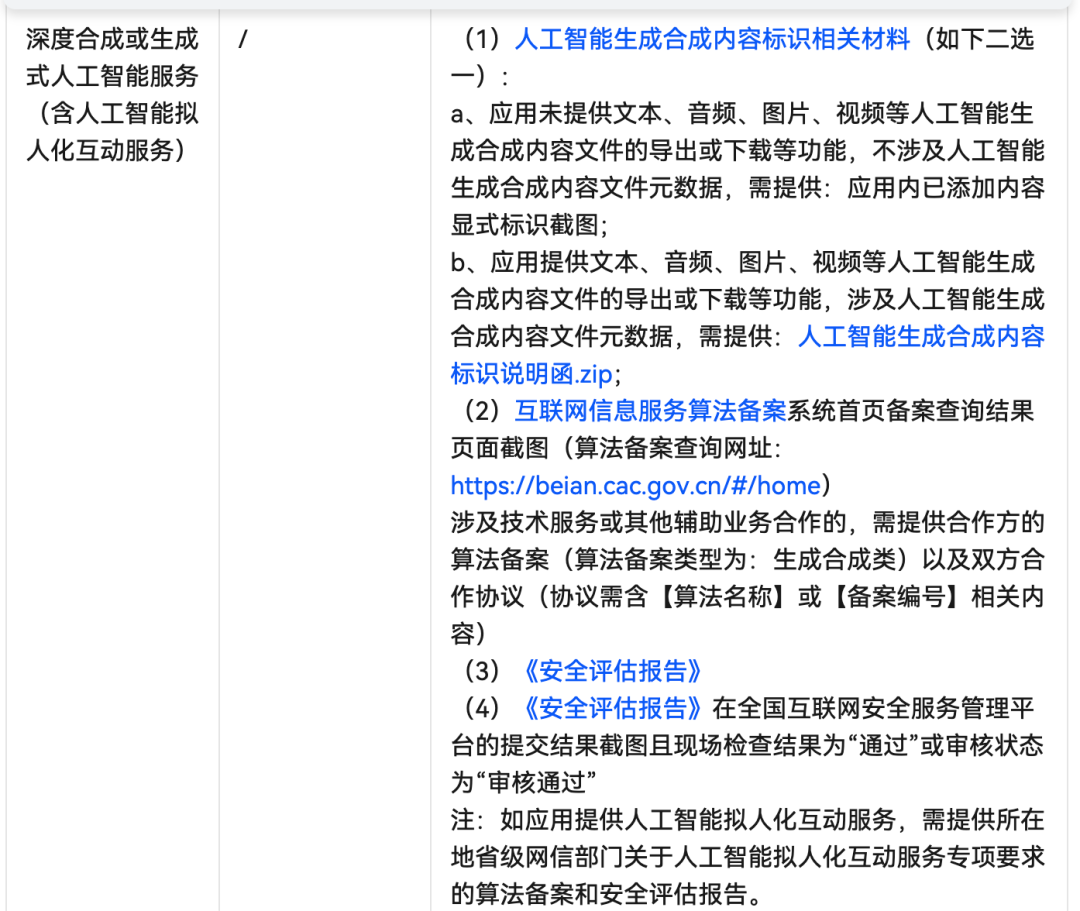
Huawei AppGallery: materials required for deep synthesis or generative AI services
Screenshot from the original post, in Chinese. DCC's English reading follows.
*DCC's English reading of the screenshot:* For "deep synthesis or
generative AI services (including AI anthropomorphic interaction
services)", Huawei requires: **(1)** materials on labeling AI-generated and
synthesized content, one of two kinds: (a) where the app offers no export
or download of AI-generated text, audio, image or video files and so
involves no file metadata, a screenshot of the explicit labels added in the
app; (b) where it offers such export or download and so involves file
metadata, a labeling explanation letter (a downloadable template);
**(2)** a screenshot of the search result page from the home page of the
Internet Information Service Algorithm Filing system (beian.cac.gov.cn).
Where technical services or other auxiliary business cooperation is
involved, the partner's algorithm filing (of the generation and synthesis
type) and the two parties' cooperation agreement, which must contain the
algorithm name or the filing number; **(3)** the security assessment
report; **(4)** a screenshot of the report's submission result on the
national platform, showing the on-site inspection result as "passed" or the
review status as "review passed". Note: an app that offers AI
anthropomorphic interaction services must provide the algorithm filing and
the security assessment report required by the provincial cyberspace
administration's special requirements for those services.
A reader adds that in practice, a generation and synthesis algorithm filing
plus a security assessment is enough to get listed. A large-model filing or
registration is not required; although the law requires both filings, in
practice only the algorithm filing is needed. Why do app stores check at
all? Article 13 of the
[Provisions on the Administration of Deep Synthesis of Internet Information Services](/laws/deep-synthesis-provisions/)
has long required app stores to verify the security assessment and filing
status of deep synthesis apps. Later, Article 7 of the
[Measures for the Labeling of AI-Generated and Composed Content](/laws/ai-content-labeling-measures/)
expressly required stores, when reviewing a listing, to ask the developer
whether it provides generation or synthesis services and to verify the
relevant labeling materials. What Apple has changed is to put both
declarations into the developer back end and to set a verification deadline
for existing apps. [1] [3]
Where a version passes app review but the compliance declarations have
not passed verification, Apple may release that version in the other selected regions,
but the China mainland store still waits until verification passes. [1]
#### (2) For AI generation or synthesis services, can you use your vendor's filing number?
If the app offers AI chat, image or video generation, or voice or face
generation and editing, the first declaration must be answered "yes".
What Apple asks for is an approved large-model filing number **or** an
algorithm filing number. Both the Chinese and the English text say "or".
As far as this field is concerned, one of the two is enough (a reader has
confirmed that in the system the two are indeed alternatives) [1]; there is
no need to provide both a large-model filing number and an algorithm filing
number.
What if you have no filing number of your own and only call someone else's
model through an API? My guess is that the technical support provider's
algorithm filing number, plus an authorization document, may be accepted.
Otherwise Apple would not say: "If your app's AI functions use third-party
technology, you must also provide an authorization certificate or usage
agreement issued by the technology provider." Huawei's acceptance of a
partner's algorithm filing also gives a domestic listing precedent. [1] [2]
Apple's own position is, of course, what counts in the end.
Two questions still need Apple to clarify: (1) Without a number of its own,
is a developer's vendor number plus authorization agreement enough to pass
the actual verification? (2) Can the "launch number" (上线编号) that a
large-model application obtains after registering a large model with the
local cyberspace administration be entered in this field on its own? If it
can, doing a large-model registration may be the more convenient route.
As for the operator's own algorithm filing or large-model registration
required by law, that still has to be judged separately, even if the store
accepts the vendor's materials. [1] [4]
#### (3) The security assessment: every document has to be your own
In the second declaration Apple gives two examples: "If your app includes
functions such as disseminating AI-generated or synthesized content, or
enabling end-to-end encrypted instant messaging (EIM), you must submit a
record showing that your security assessment report passed on the National
Internet Security Management Service Platform, plus a copy of the security
assessment report." [1]
This security assessment report is not the same thing as the security
assessment in large-model filing; see Part III. The conclusion is clear:
the security assessment report must be the app's own.
The 2018
[Provisions on the Security Assessment of Internet Information Services with Public Opinion Attributes or Social Mobilization Capacity](/laws/public-opinion-security-assessment-provisions/)
list the situations in which a security assessment shall be carried out,
and require the assessment to cover measures such as handling illegal and
harmful information, complaints and reports, and assisting regulators and
law enforcement in accordance with law.
*[The original reproduces Articles 2 and 3 of the 2018 Provisions here, with
the author highlighting "chat rooms, communication groups" in Article 2 and
three of the triggers in Article 3. Their substance is set out in Part
III(1) below.]*
Disseminating AI-generated or synthesized content is easy to understand.
Why does end-to-end encrypted instant messaging appear here too?
End-to-end encryption usually means only the endpoints of a communication
can decrypt a message (Telegram), and relay servers cannot read the content
directly. If the product also supports group chats, then once a user
reports illegal information in a group, what information the service can
obtain and what measures it can take will certainly be a focus of the
regulators.
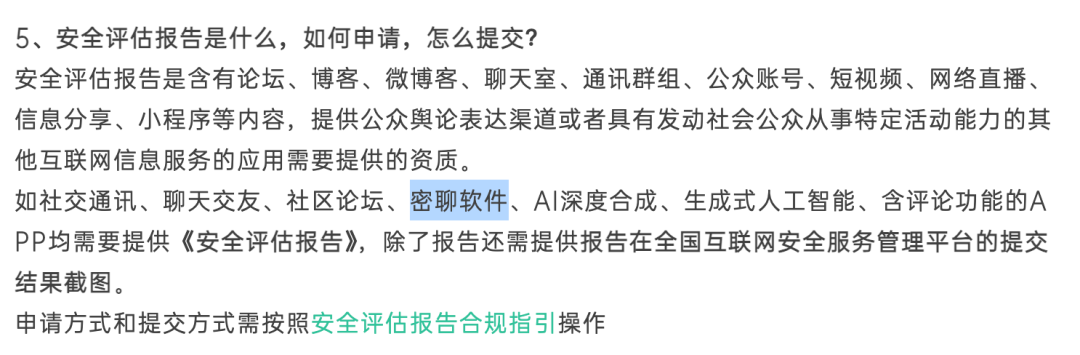
OPPO's app-review FAQ, question 5: which apps need a security assessment report
Screenshot from the original post, in Chinese, with the author's highlight. DCC's English reading follows.
*DCC's English reading of the screenshot:* "5. What is a security
assessment report, how do you apply, and how do you submit it? A security
assessment report is a qualification required of apps that include forums,
blogs, microblogs, chat rooms, communication groups, public accounts, short
video, live streaming, information sharing, mini-programs and similar
content, or other internet information services that provide channels for
public opinion or are capable of mobilizing the public to engage in
specific activities. For example, social messaging, chat and dating,
community forums, *encrypted chat software* (highlighted), AI deep
synthesis, generative AI, and apps with comment functions all need to
provide a *Security Assessment Report*. Besides the report, a screenshot of
its submission result on the National Internet Security Management Service
Platform is required. Apply and submit according to the security
assessment report compliance guide."
Before Apple, OPPO also required a *Security Assessment Report* from
"encrypted chat software, AI deep synthesis, generative AI, and apps with
comment functions". [1] [5] [6]
Once Apple's security assessment requirement is triggered, you hand in two
things: this app's report, bearing the company seal, and the pass
screenshot from the National Internet Security Management Service
Platform. A developer may assess itself or engage a professional
institution, but the subject of the assessment has to be its own app. A
vendor's letter of authorization does not solve this. [1] [5]
### II. What exactly is algorithm filing?
Why should a company doing AI image generation read the
[Provisions on the Administration of Algorithmic Recommendation Services for Internet Information Services](/laws/algorithmic-recommendation-provisions/)?
Because "algorithmic recommendation" here is broad. It covers five kinds of
algorithmic technology: generation and synthesis, personalized push,
ranking and selection, search and filtering, and dispatch and
decision-making. AI image generation and AI writing can both fall into the
first.
Who must file is set by a separate threshold in Article 24: service
providers that use algorithmic recommendation technology to provide
internet information services within China and have public opinion
attributes or social mobilization capacity shall file within ten working
days of the date they begin providing the service. [7]
The Deep Synthesis Provisions, in force since January 2023, go further and
distinguish two roles. Again taking AI image generation as the example: the
operator of the app that provides image generation directly to users is the
deep synthesis service provider; the vendor that supplies image-generation
technology to the operator is the deep synthesis technical support
provider. Article 19 requires service providers with public opinion
attributes or social mobilization capacity to complete filing formalities,
and technical support providers to do so by reference.
The CAC's filing system also makes clear that deep synthesis filing
corresponds to the generation and synthesis category of algorithm filing.
In other words, the one is contained in the other. A company has to judge
its obligations according to its own role. [3] [8]
*[The original shows a screenshot from the CAC filing system listing the
algorithm filing types (generation and synthesis, personalized push,
ranking and selection, search and filtering, dispatch and decision-making)
and stating that deep synthesis filing is "the same as" the generation and
synthesis category of algorithm filing.]*
What do you mainly fill in when filing? The provider's name, the form of
service, the field of application, the algorithm type, the algorithm
self-assessment report and the content proposed for public display. A
service provider must also link the products and functions that use the
algorithm; a technical support provider must explain how it provides
technical support to others. The self-assessment report here is submitted
with the algorithm filing and focuses on how the algorithm works, what
risks it carries, and how they are prevented. After filing, the number must
be displayed in a prominent position on the website or app through which
the service is provided, with a link to the public information. [7] [9]
One answer in the CAC's FAQs is very practical: filing is done per
algorithm. Where several products of the same entity use the same
algorithm, it can be filed once and those products linked to it; where
several different algorithms are used, each is filed separately and linked
to the corresponding products. A company with three apps does not
necessarily need three algorithm filing numbers. [15]
### III. What does the security assessment assess?
Large-model filing requires a security assessment, and Apple's listing also
requires a security assessment report. How do the two relate?
The question has a history. Article 6 of the *Measures for the
Administration of Generative AI Services (Draft for Comment)*, published in
April 2023, named the 2018 Provisions directly: under that draft, before
using generative AI products to provide services to the public, a security
assessment was to be declared under those Provisions. But the final
version, the
[Interim Measures for the Management of Generative Artificial Intelligence Services](/laws/genai-services-interim-measures/)
published in July 2023, wrote in Article 17 that providers of generative AI
services "with public opinion attributes or social mobilization capacity"
shall "carry out a security assessment in accordance with relevant state
provisions" and complete algorithm filing formalities. The final text kept
the security assessment obligation but no longer named the 2018
Provisions. [12]
So, in legislative history, the two assessments are connected. In actual
practice, you still have to tell apart what materials are submitted, what
is being assessed, and what proof you end up with.
The Zhejiang Cyberspace Administration's guide lists the 2018 security
assessment, which it calls the "internet new technology and new
application security assessment", separately from "generative AI (large
language model) launch filing". [9]
*[The original reproduces two passages from the Zhejiang guide here: the
five situations requiring a new technology and new application security
assessment (the same five triggers as Article 3 of the 2018 Provisions),
and the three steps of generative AI (large language model) launch filing:
determine applicability (an internet information service provider using
generative AI (LLM) technology to provide information services to the
public, with public opinion attributes and social mobilization capacity,
needs to file); obtain the filing form from the provincial cyberspace
administration before providing the service and fill in the service's basic
situation, model development, service and security safeguards, security
assessment and supporting materials; and submit the materials offline to
the Zhejiang Cyberspace Administration.]*
#### (1) The "two-new" assessment looks at what services this app provides and how it controls the risks
"Two-new" refers to new technologies and new applications. As far as the
public security platform materials Apple asks for are concerned, this
corresponds to the security assessment under the 2018 Provisions.
*[The original shows a screenshot of the home page of the National Internet
Security Management Service Platform (beian.mps.gov.cn), with links to its
website filing, service provider filing, app market filing and security
assessment guides.]*
It covers services such as forums, chat rooms, communication groups, public
accounts, short video, live streaming, information sharing and
mini-programs, and products that include such functions. It also covers
other services that give the public a channel for expressing opinion, or
that are capable of mobilizing the public to engage in specific
activities. [5]
When must it be done? The Provisions set two groups with different
deadlines for submission. [5]
The first group must be submitted before going live or adding the relevant
function. For example: launching a service with those attributes, or adding
a community for user works to an existing app. Or: adopting new
technologies and new applications that significantly change the service's
functional attributes, technical implementation or basic resource
configuration, and in turn significantly change its public opinion
attributes or social mobilization capacity.
The second group must be submitted within 30 working days of the
situation arising. It includes: a marked growth in users that significantly
changes those attributes or capacity; illegal and harmful information
having spread in a way that shows existing measures have difficulty
effectively preventing and controlling the risk; and written notice from a cyberspace administration or
public security organ at or above the prefecture-level city to carry out an
assessment.
Who oversees it? The company submits its report on the National Internet
Security Management Service Platform, to the cyberspace administration and
public security organ at or above the prefecture-level city where it is
located. The two departments review it in writing according to their
respective duties, and may require further explanation or a new
assessment; where they consider it necessary they carry out on-site
inspection, in principle jointly. For services with relatively high
security risks that may affect national security, social order and the
public interest, cyberspace administrations and public security organs at
or above provincial level organize expert review. The cyberspace
administration coordinates overall, and the public security organs
periodically report on the assessment work to it. [5]
The two departments have indeed done this work together. In 2021, because
some voice social apps and apps involving "deepfake" technology had not
gone through the security assessment procedure, the CAC and the Ministry of
Public Security directed local cyberspace administrations and public
security organs in several places to summon 11 companies for talks, urging
them to carry out assessments and rectify hidden risks. [10]
What exactly goes in the report? 西部数码 (West Digital, a hosting
provider) has published an example filled in column by column for an app.
The "main content" is divided into seven columns of up to 450 characters
each. Roughly, they cover: who is responsible for security management; how
user identity is verified and registration information retained; how
operation logs and posting records are kept; how illegal and harmful
information in accounts, groups and posted content is handled; how personal
information is protected and dissemination risks prevented; how complaints
and reports are accepted; and how the app assists regulators and law
enforcement in accordance with law. The 450-character figure is the example
given for the filing interface. [11]
Take a community for user works. Where does a user report a non-compliant
image? Who takes the report? What record is kept after the image is taken
down? These are facts this app can account for. Following the public
operating guide, you select the assessment subject and version, fill in the
content, download the report the system generates, print it, seal it, scan
it and upload it, then check the review result. To see what the report and
the pass screenshot look like, both Huawei and Xiaomi have sample
images. [11]
#### (2) The security assessment in large-model filing looks at measured results for the generative AI service
The TC260 technical document TC260-003,
[Basic Security Requirements for Generative Artificial Intelligence Services](/laws/tc260-genai-basic-security-requirements/),
states expressly that "when service providers complete filing formalities,
they carry out a security assessment in accordance with Chapter 9 of this
document and submit the assessment report." The current recommended
national standard
[GB/T 45654—2025, *Cybersecurity Technology — Basic Security Requirements for Generative Artificial Intelligence Services*](/laws/gbt-45654-genai-basic-security-requirements/)
can also serve as a reference for the assessment. [14]
*[The original shows two screenshots here: the passage from TC260-003's
introduction quoted above, and the scope clause of GB/T 45654—2025, which
covers training-data security, model security and security measures, and
applies to providers' generative AI activities while also serving as a
reference for competent authorities and third-party assessors.]*
For example, to show that a model can answer questions safely, the report
has to explain how the training corpus is sample-checked, what test
questions are used to check generated content, whether questions that
should be refused are refused, whether normal questions are wrongly
refused, and what the measured results are. After the company submits the
report, there is also an assessment organized by the competent
authorities.
The process Fujian has published shows that the province commissions a
professional institution to assess the model's generated content, and that
the central review includes security testing. In this filing process, the
security assessment is passed first and the filing is announced
afterwards. [13] [14]
Can the two sets of materials be reused? A company's existing model test
results can serve as the basis for the relevant technical facts when
writing the app's report. But even if content safety was tested when the
model was filed, that does not establish that this app already has a pass
record on the National Internet Security Management Service Platform. That
record, and the sealed report that goes with it, is what Apple checks.
[1] [13]
### IV. How do large-model filing and registration differ?
#### (1) Building your own model versus calling someone else's: how do the routes differ?
The CAC's 2026 filing FAQs put it directly: generative AI services with
public opinion attributes or social mobilization capacity provided to the
public in China shall undergo a security assessment and complete the filing
procedure; applications or functions that directly call the capabilities of
an already-filed large model through an API or similar means may, provided
they comply with relevant laws and regulations, be registered locally. So a
developer that plugs in a third-party model should first check whether the
model it actually calls has been filed, and then judge whether its own
application or function can take the local registration route. [4] [15]
Fujian spells this judgment out in detail. Where a filed model is called
directly, generation is text only, and the corpus used for further training
is under 1,000 MB, the Fujian practice is provincial registration. Where
the training corpus exceeds 1,000 MB, or generation includes images, audio
or video, the route is filing with the CAC. The 1,000 MB line is Fujian's
published practice; companies elsewhere should check their own local
requirements. [13]
Fujian also makes clear that where a filed model is called entirely, its
content safety measures are inherited, and there is no further
development, it is treated as the same model and need not be filed again;
and a large model for internal use that does not provide services to
others need not be filed. [13] [15]
The CAC's *FAQ Compilation on Filing of Generative AI Services (Including
Anthropomorphic Interaction)* also makes clear that large language models
with the same training corpus, algorithms and security measures, differing
only in parameter size, may be treated as the same model and need not be
filed again. [8]
#### (2) How are registration and filing each done?
Under the new system launched in November 2026, a company first enters its
entity information in the "Internet New Technology and New Application
Information Service Filing System", then submits the generative AI service
filing or registration materials to the local cyberspace administration.
Taking Fujian as the example, the main difference between the two routes is
the level of review. [8] [13] [15]
For provincial registration, you first obtain the template form and
materials list from the local city-level cyberspace administration and
submit sealed materials; the city conducts the initial review and the
province the second review. After the provincial review passes, a
professional institution is commissioned to assess the generated content,
and the views of public security and other relevant departments are sought
at the same time. Once the assessment passes and no department objects,
the registration number is issued after deliberation and announced. Local
registration also includes a security assessment step. [13]
For CAC filing, you may obtain the materials from the local provincial or
city-level cyberspace administration, and the formal application goes to
the province for initial review. Within Fujian there is likewise a
professional assessment and consultation of departments; after
deliberation by the provincial Party committee's cyberspace affairs office
and with the consent of the provincial Party committee's cyberspace affairs
commission, it goes to the central cyberspace authorities for review. Only
after consultation with the relevant ministries, security testing and every
other step has passed does the CAC announce the filings in batches.
Fujian expressly requires the launch filing form and attachments, sealed
paper originals and scanned copies, plus a test API that actually works
and has some concurrent processing capacity, and the calling code.
Registration progress can be checked with the city-level cyberspace
administration that accepted the application; filing progress can be
checked through the provincial large-model ecosystem service station. [13]
There is one more launch step that is easy to miss. The CAC requires
generative AI applications or functions already online to display, in a
prominent position or on the product details page, the filed or registered
service they use, stating the model name and the filing number or launch
number.
The regulator's announcement expressly recognizes the launch number for
display purposes; whether Apple's filing-number field will accept it on its
own remains for Apple to clarify. [1] [4]
#### (3) For AI companionship, also check the anthropomorphic interaction rules
If an app plugs in a filed model and lets users chat with a fixed virtual
character over a long period for emotional companionship, it must also
look at the
[Interim Measures for the Management of AI Anthropomorphic Interaction Services](/laws/ai-anthropomorphic-interaction-measures/),
in force since July 15, 2026. Whether they apply depends on whether the
service provides the public in China with sustained emotional interaction
that simulates the personality traits, thinking patterns and communication
style of a natural person. A writing assistant that occasionally says
"you've worked hard" is a different case from an app that makes emotional
companionship a product feature. [15] [16]
For operators within scope there are two direct requirements. First,
algorithm filing: filing, amendment or cancellation under the Algorithmic
Recommendation Provisions, with cyberspace administrations verifying the
filing materials annually. Second, a dedicated security assessment: it is
required when launching an anthropomorphic interaction service or adding
such a function to an existing app. [16]
Back to the question developers care about most: "I only have my vendor's
filing number. Can I get listed?"
1. For Apple's AI declaration, the technical support provider's deep
synthesis algorithm filing number plus a matching authorization document
may possibly get through; doing a large-model registration may be the
more convenient route.
2. For Apple's security assessment declaration, once it is triggered, you
need this app's own report and pass record.
As for compliance obligations such as application registration, your own
algorithm filing and the dedicated anthropomorphic interaction assessment,
they ultimately depend on what service the operator provides, and to whom,
once it has plugged the model in. [1] [4] [7] [16]
## The author's notes and sources
*Translated. URLs are as given in the original.*
**[1]** Apple App Store Connect release notes (November 16, 2026) and the
Chinese and English guidance "View China mainland compliance information".
The deadline for the declarations, and the requirements for third-party
authorization and for security assessment screenshots, are in the latter
two.
https://developer.apple.com/cn/help/app-store-connect/release-notes/ ·
https://developer.apple.com/cn/help/app-store-connect/manage-compliance-information/view-china-mainland-compliance-information ·
https://developer.apple.com/help/app-store-connect/manage-compliance-information/view-china-mainland-compliance-information
**[2]** Xiaomi, *Requirements for AI (Generation and Synthesis) Services*;
Huawei AppGallery qualification requirements, under the item "Deep
synthesis or generative AI services".
https://dev.mi.com/xiaomihyperos/documentation/detail?pId=2065 ·
https://developer.huawei.com/consumer/cn/doc/App/80301/
**[3]** Provisions on the Administration of Deep Synthesis of Internet
Information Services, Articles 13, 15, 19 and 20; Measures for the Labeling
of AI-Generated and Composed Content, Article 7.
https://www.cac.gov.cn/2022-12/11/c_1672221949354811.htm ·
https://www.cac.gov.cn/2025-03/14/c_1743654684782215.htm
**[4]** CAC, *Announcement on Publishing Information on Filed Generative AI
Services (July to August 2026)*, which sets out who registers locally, the
cumulative number as of August 31, 2026, and the requirement to display
the information once online.
https://www.cac.gov.cn/2026-09/14/c_1791136833136332.htm
**[5]** The Provisions on the Security Assessment of Internet Information
Services with Public Opinion Attributes or Social Mobilization Capacity,
and the two departments' explanatory release. Articles 2 to 7 cover the
situations in which they apply, the content of the assessment and the
submission deadlines; Articles 8 to 10 and 14 cover review, on-site
inspection and the division of labor between the departments. The third
URL is the National Internet Security Management Service Platform.
https://www.cac.gov.cn/2018-11/15/c_1123716072.htm ·
https://www.cac.gov.cn/2018-11/20/c_1123740989.htm ·
https://beian.mps.gov.cn/
**[6]** OPPO, *App Review FAQ*. Question 5 lists "encrypted chat software",
AI deep synthesis and generative AI apps; question 6 sets out the
requirements for the report and the pass screenshot.
https://open.oppomobile.com/bbs/forum.php?mod=viewthread&tid=6307
**[7]** Provisions on the Administration of Algorithmic Recommendation
Services for Internet Information Services, Articles 2 and 24 to 27.
https://www.cac.gov.cn/2022-01/04/c_1642894606364259.htm
**[8]** CAC, *Notice on the Launch of the Internet New Technology and New
Application Information Service Filing System*, and the filing system
itself. Question 3 of the *FAQ Compilation on Internet Information Service
Algorithm Filing*, under "User Guide" on the system's home page, explains
how to link several products to one algorithm.
https://www.cac.gov.cn/2026-11/09/c_1795978604463007.htm ·
https://beian.cac.gov.cn/
**[9]** Zhejiang Cyberspace Administration, *Zhejiang Province Internet
Information Service Security Assessment Guide*. Part III lists separately
the procedures for the new technology and new application security
assessment, algorithm filing, and large language model launch filing.
https://www.zjwx.gov.cn/art/2024/12/18/art_1694583_58876230.html
**[10]** CAC and Ministry of Public Security, *CAC and MPS Strengthen the
Security Assessment of New Internet Technologies and New Applications for
Voice Social Apps and Apps Involving Deepfake Technology*, March 18, 2021.
https://www.cac.gov.cn/2021-03/18/c_1617648089558637.htm
**[11]** 西部数码 (West Digital), filling instructions for the *Security
Assessment Report*, a third party's column-by-column example. Huawei's and
Xiaomi's developer guides provide sample images of the report and the pass
screenshot; questions 4 and 5 of Huawei's FAQ explain the difference
between self-assessment, commissioned assessment and authorized use.
https://sy.west.cn/faq/list.asp?Unid=2561 ·
https://developer.huawei.com/consumer/cn/doc/app/50108/ ·
https://dev.mi.com/xiaomihyperos/documentation/detail?pId=1347
**[12]** Article 6 of the *Measures for the Administration of Generative AI
Services (Draft for Comment)*, published April 11, 2023, which cites the
2018 Provisions directly. Compare Articles 2 and 17 of the *Interim
Measures for the Management of Generative AI Services*, published in July
2023 and in force from August 15, 2023.
https://www.cac.gov.cn/2023-04/11/c_1682854275475410.htm ·
https://www.cac.gov.cn/2023-07/13/c_1690898327029107.htm
**[13]** Fujian Cyberspace Administration, "Generative AI Large Model Filing
Service Zone". Questions 1 to 4 on its home page cover the conditions of
application, the procedure, the materials and progress checks; the 1,000 MB
figure in the article is Fujian's practice.
https://m.fjwx.gov.cn/beian/
**[14]** TC260 technical document TC260-003, *Basic Security Requirements
for Generative AI Services* (introduction and Chapter 9), TC260 expert
commentary, and the recommended national standard GB/T 45654—2025,
*Cybersecurity Technology — Basic Security Requirements for Generative AI
Services*.
https://www.c-csa.cn/u_file/photo/20240804/d83608a539.pdf ·
https://www.tc260.org.cn/tc260/hygd1/202403/42628d8f510f43f0b66a5590bb23b809.shtml ·
https://openstd.samr.gov.cn/bzgk/std/newGbInfo?hcno=F67D3F376E0A0A0FF5317FB36B32A30A
**[15]** CAC filing system, *FAQ Compilation on Filing of Generative AI
Services (Including Anthropomorphic Interaction)*, available under "User
Guide" on the system's home page. Questions 1 and 2 cover filing and local
registration; question 3 the cases in which repeat filing is not needed;
questions 4 and 5 the scope of the anthropomorphic interaction security
assessment and how filing materials are submitted.
https://beian.cac.gov.cn/
**[16]** *Interim Measures for the Management of AI Anthropomorphic
Interaction Services* and the CAC's answers to reporters' questions.
Article 2 sets the scope; Articles 22 to 27 cover the dedicated security
assessment, app store verification, algorithm filing and annual
verification.
https://www.cac.gov.cn/2026-04/10/c_1777558395078289.htm ·
https://www.cac.gov.cn/2026-04/10/c_1777558395284407.htm
---
## DCC's reading
*What follows is DCC's, not the author's.*
- **Two declarations, two different borrowing rules.** The article's most
useful line is the split in its conclusion. For Apple's AI declaration, a
vendor's filing number plus an authorization *may* do. The author says
so as a guess, and Apple has not confirmed it. For a triggered security
assessment, nothing can be borrowed: the report, its seal and the pass
record on the MPS platform must all belong to the app.
- **The security assessment is a public-security item, not a CAC filing.**
The 2018 assessment is submitted on beian.mps.gov.cn and reviewed by both
the cyberspace administration and the public security organ. Teams that
have tracked only the CAC's filing portal may not have it on their list.
Apple's example of end-to-end encrypted messaging shows it reaches beyond
AI.
- **A store's practice is not the law.** The reader's comment that, in
practice, a generation and synthesis algorithm filing plus a security
assessment is enough, without a large-model filing or registration,
describes what Android stores accept. As the author notes, the operator's own filing or
registration obligations "still have to be judged separately". Passing a
store's verification does not settle them.
- **The 1,000 MB and text-only line is Fujian's.** The author flags this
twice. Other provinces set their own practice for when an API-calling
application can register locally rather than file with the CAC.
- **Deadline.** Existing apps on the China storefront have until January
31, 2027. Until verification passes, a new version can ship elsewhere but
not on the China mainland App Store.
— *数据何规, 由苹果App新政厘清 AI评估/备案 ("Apple's New App Policy as an
Occasion to Sort Out AI Assessment and Filing"), November 19, 2026.
Translated in full by DCC; the editor's note, figure readings and "DCC's
reading" are DCC's own.
[Original (Chinese).](https://mp.weixin.qq.com/s/G-7OU4Eey6Jq0GClSz4pdg)*
— Not legal advice.