Promulgated by: General Office of the Jiangsu Provincial People’s Government (江苏省人民政府办公厅).
Document No.: 苏政办规〔2026〕9号 (Su Zheng Ban Gui [2026] No. 9).
Issued November 12, 2026. Effective January 1, 2027; valid until December 31, 2028.
Translation note — DCC. Translated in full from the Chinese text as republished by the National Data Administration under “Local Developments” (地方动态) on November 21, 2026 (source: Jiangsu Provincial People’s Government). Two bodies with similar Chinese names are kept apart throughout: the public data operation-management institution (公共数据运行管理机构) runs the government’s public data platform, and the public data operating institution (公共数据运营机构) is the party authorized to develop public data for the market. 数据主管部门 is “data administration department”; 公共管理和服务机构 is “public management and service institutions”; 回流 is “return flow”, meaning data collected through a higher-level system being sent back to the locality it came from. The annex flowchart is reproduced at the end with DCC’s English reading.
Notice of the General Office of the Provincial Government on Issuing the Jiangsu Province Provisions on the Responsibility System for the Development and Utilization of Public Data Resources (Trial)
(苏政办规〔2026〕9号)
To the people’s governments of all cities and counties (county-level cities and districts), and all commissions, offices, departments, bureaus and directly subordinate units of the Province:
The Jiangsu Province Provisions on the Responsibility System for the Development and Utilization of Public Data Resources (Trial) have been approved by the Provincial People’s Government and are hereby issued to you. Please organize their implementation conscientiously.
General Office of the Jiangsu Provincial People’s Government
November 12, 2026
(This document is released to the public)
Jiangsu Province Provisions on the Responsibility System for the Development and Utilization of Public Data Resources (Trial)
Chapter I — General Provisions
Article 1. These Provisions are formulated in order to deepen the development and utilization of public data resources, improve working mechanisms and fully release the value of data elements, in accordance with the Data Security Law of the People’s Republic of China, the Regulations on Network Data Security Management, the Regulations on the Sharing of Government Data, the Jiangsu Province Data Regulations and other laws and regulations, pursuant to the requirements of the Opinions of the General Office of the CPC Central Committee and the General Office of the State Council on Accelerating the Development and Utilization of Public Data Resources, and in light of the actual conditions of this Province.
Article 2. These Provisions apply to units and individuals taking part in activities for the development and utilization of public data resources within the administrative area of this Province.
Article 3. A responsibility system for the development and utilization of public data resources is implemented. A working pattern of collaborative governance shall be built and data development and security coordinated, taking the promotion of compliant and efficient circulation and use of data as the main line and the raising of the level of resource development and utilization as the goal, on the basis that where there is business there must be data, and where there is data it must be supplied for development (有业务必有数据、有数据必供开发). Equal weight shall be given to incentive and constraint; mechanisms for incentives and for fault tolerance and error correction shall be improved; and accountability for dereliction of duty and exemption from liability for due diligence (失职追责、尽职免责) shall be carried through.
Chapter II — Content of Responsibilities
Article 4. Local people’s governments at or above the county level are responsible for the development and utilization of public data resources within their administrative areas. This mainly includes:
- implementing the decisions and arrangements of the Party Central Committee and the State Council on the reform of market-oriented allocation of data elements, and the relevant work requirements of higher-level Party committees and governments;
- incorporating the development and utilization of public data resources into the plans for national economic and social development, and formulating and implementing policies and measures to activate the potential of data elements and keep data secure and controllable;
- establishing and implementing the chief data officer (首席数据官) system, strengthening the coordination of data work, and regularly studying and resolving major issues in the development and utilization of public data resources;
- strengthening funding for the development and utilization of public data resources, with the funds required included in the fiscal budget at the corresponding level.
Article 5. Data administration departments are responsible for the overall coordination, supervision and administration of the development and utilization of public data resources. This mainly includes:
- organizing, guiding, coordinating and supervising the development and utilization of public data resources, and formulating and implementing the relevant management systems;
- where the collection of public data involves multiple entities, designating the data-source department that takes the lead in collection;
- organizing the compilation of the public data catalogue for the administrative area, and improving the management of the list of high-use-value public data;
- promoting the registration of public data resources, sharing and opening, authorized operation, the cultivation of the ecosystem and innovation in scenarios;
- performing data security duties in advancing digital government and related work, and drafting and organizing the implementation of the relevant data security systems;
- promoting the chief data officer system, and organizing publicity, training and implementation;
- regularly evaluating and assessing the operational effectiveness of public data operating institutions;
- other duties provided by laws, regulations, rules and by the State and the Province.
Article 6. Public management and service institutions are responsible for the supply, shared use and quality management of their own data, and bear the primary responsibility for data management and for security and compliance. This mainly includes:
- fully implementing the chief data officer system, and promoting the coordinated conduct of data management and operational work;
- designating the specific unit responsible for the development and utilization of public data resources, and achieving centralized and unified management of data;
- compiling and dynamically maintaining the public data catalogue, and pooling data into the public data platform completely, accurately and promptly by reference to the catalogue and the list of high-use-value public data. The data provider bears responsibility for security management before the data is provided, and the data recipient and user bears responsibility for security management after the data is received;
- carrying out governance of data at source and implementing whole-process quality management, ensuring that data is authentic, accurate, complete and timely;
- performing its duties as industry authority, taking the lead in building the public data resource center for its industry, interconnecting it with the public data platform, and building thematic databases on the public data platform according to application needs;
- for public data collected through vertically managed business systems, on the premise that security is ensured and according to local needs, carrying out return flow (回流) completely, accurately and promptly, doing a good job of system connection and operational coordination, and setting no additional restrictive conditions. Localities develop and utilize the returned public data in accordance with the provisions. Provincial industry authorities are responsible for applying for the return flow of data from the vertically managed business systems of State Council departments, and for coordinating and promoting the return of data to localities;
- carrying out the development and utilization of public data resources on the public data platforms of the Province and of the districted cities; it shall not build new channels for sharing and opening or for authorized operation outside the public data platforms, and those already built shall be integrated and merged;
- carrying out sharing in accordance with the provisions, standardizing the acceptance of and response to sharing applications, with the data recipient and user keeping records of the use of shared data. Sharing shall not be refused where there is no express provision of a law, an administrative regulation or a decision of the State Council;
- carrying out opening in accordance with the provisions, opening in a secure and orderly manner public data that is closely related to people’s livelihood and urgently needed by society;
- promoting authorized operation in accordance with the provisions, carrying out the registration of public data resources, guiding the compilation of the catalogue of public data resources for authorized operation in its industry, being responsible for the timely, complete, accurate and stable supply of public data resources for authorized operation, and supporting innovation in application scenarios. It shall not supply public data to the market in any form outside the authorized operation and opening mechanisms;
- it shall not terminate or alter public data already supplied without authorization, and shall not, by adding conditions or otherwise, obstruct or affect without authorization the development and utilization of public data that has already been shared, opened or placed under authorized operation;
- handling, in accordance with the provisions, data objections relating to sharing and opening and to authorized operation;
- performing its primary responsibility for data security, and establishing and implementing data security management and other systems;
- other duties provided by laws, regulations, rules and by the State and the Province.
Article 7. Public data operation-management institutions are responsible for the specific implementation of public data management work, and bear the primary responsibility for data management and for security and compliance on the public data platform. This mainly includes:
- being responsible for the construction, operation, maintenance and management of the public data platform at their level, and carrying out the collection and governance of public data;
- being responsible for the operational management of the development and utilization of public data resources, carrying out the review of sharing and opening for conformity with technical specifications and the supply of public data for authorized operation, promptly prompting the relevant institutions to handle requests concerning sharing and opening and authorized operation, and carrying out efficiency monitoring;
- improving the public data resource registration platform, providing standardized and convenient registration services, and carrying out the acceptance of applications for public data resource registration, formal review, public notice, code issuance and other work;
- taking the lead in compiling the catalogue of public data resources for authorized operation, and advancing the supply at source of public data for authorized operation; receiving applications for public data resources from public data operating institutions and supplying data in accordance with the provisions; establishing the public data resource authorized-operation domain and supporting the construction of authorized operation platforms; and working together to match supply and demand for public data under authorized operation and to optimize the data-supply mechanism;
- implementing security protection of the public data platform, regularly carrying out risk assessments, security testing and emergency drills, establishing data backup and disaster recovery mechanisms, and carrying out regular monitoring and early warning of security risks;
- other duties provided by laws, regulations, rules and by the State and the Province.
Article 8. Public data operating institutions are responsible for the development and utilization of public data resources within the scope of their authorization, and bear the primary responsibility for data management and for security and compliance on the public data resource authorized operation platform. This mainly includes:
- building and managing the public data resource authorized operation platform within the public data resource authorized-operation domain, processing the authorized data, establishing and dynamically maintaining a data resource catalogue, making clear the scope and period of use of the authorized data, tracking and feeding back on data quality, and ensuring the quality of data services;
- organizing the matching of data supply and demand, and forming the requirements for public data resources under authorized operation for submission to the public data operation-management institution;
- organizing and implementing authorized operation, mainly including issuing announcements, supervising data processing activities, managing the data product catalogue, and disclosing information;
- providing corresponding technical support, business consultation and other services for the development and utilization of authorized data, cultivating data merchants (数据商) and third-party professional service institutions, and promoting the healthy development of the public data operation ecosystem;
- being responsible for the review of public data products, including but not limited to the use made of public data, the risk of direct exposure of non-public raw data, the risk of leakage or misuse of personal information and trade secrets, and data export;
- establishing and improving security management systems and compliance monitoring mechanisms, and advancing and urging the implementation of the primary responsibility for security and compliance in data development and utilization and in the circulation and trading of data products, ensuring conformity with laws and regulations, policies and agreements;
- other duties provided by laws, regulations, rules and by the State and the Province.
Article 9. The principal person in charge of a public management and service institution is the first person responsible for the development and utilization of public data resources in that institution.
The chief data officer is the person directly responsible for the development and utilization of public data resources in that institution, and is responsible for overall coordination and for advancing implementation.
Other persons in charge bear, according to the division of work, responsibility for the development and utilization of public data resources within the scope of their portfolios.
Article 10. The cyberspace administration, public security, state security, secrecy, cryptography administration and other departments shall, in accordance with laws and regulations and their statutory duties, guide public management and service institutions in establishing and improving whole-process data security management systems, and strengthen security supervision over activities for the development and utilization of public data resources.
Entities engaged in the development and utilization of public data resources shall comply with the laws, regulations, standards and norms on cybersecurity, data security, personal information protection, secrecy management, cryptography management and other matters.
Article 11. Finance, state-owned assets and other departments shall, in accordance with their statutory duties, work together on the supervision and administration of the development and utilization of public data resources in respect of supervision and inspection, budget performance management and the supervision of state-owned assets.
Where a public data operating institution is a state-owned enterprise of this Province, the results of the evaluation of its operational effectiveness shall at the same time be brought within the category of major special tasks in state-owned assets supervision at the corresponding level.
Article 12. Audit organs carry out audit supervision of the development and utilization of public data resources in accordance with laws and regulations.
Article 13. Discipline inspection and supervision organs, on the basis of their functions, shall strengthen supervision and inspection of the implementation of responsibilities, the exercise of power, the enforcement of systems, security management and the carrying through of policies in the development and utilization of public data resources. Inspection tour bodies (巡视巡察机构) shall bring the development and utilization of public data resources within the scope of their inspection supervision.
Chapter III — Incentives and Accountability
Article 14. Units and individuals that have fully discharged their responsibilities, achieved notable results and made outstanding contributions in the development and utilization of public data resources may, on the premise of conformity with the relevant provisions of the State and the Province, be given the following incentives:
- this serving as an important basis for the approval and acceptance of government informatization projects;
- this serving as an important reference for the arrangement of special funds for system operation and maintenance, data governance, application innovation and the like, and for the allocation of cloud and network resources;
- this serving as an important reference for recommendation to national and provincial pilot and demonstration projects on the reform of market-oriented allocation of data elements, innovative data applications and the like;
- this serving as an important reference for the commendation of staff, further training and the like.
Article 15. Development and reform, finance, data and other departments shall, on the principle that “whoever contributes, benefits” (谁贡献、谁受益) and on the premise of lawfulness and compliance, establish a mechanism for the distribution of the proceeds of authorized operation of public data resources that safeguards fairness, giving data providers and public data operating institutions an incentive to create and realize the value of data.
Article 16. Failure to perform the responsibilities for the development and utilization of public data resources, or the discovery of serious problems in monitoring and evaluation or in supervision and inspection, shall, apart from liability being pursued in accordance with law, serve as a basis for constraint in respect of project construction investment, operation and maintenance funding, and acceptance.
Article 17. Where a public management and service institution violates these Provisions, the higher-level competent department, or the data administration department at the same level in consultation with the relevant regulatory departments, shall order it to make corrections; where it refuses to make corrections or the circumstances are serious, the staff members and leaders responsible shall be given sanctions in accordance with laws and regulations.
Article 18. Where a public data operation-management institution violates these Provisions, the data administration department, in consultation with the relevant regulatory departments, shall order it to make corrections; where it refuses to make corrections or the circumstances are serious, the staff members and leaders responsible shall be given sanctions in accordance with laws and regulations.
Article 19. Where a public data operating institution violates these Provisions by using data beyond the scope of its authorization, passing data on to a third party without authorization, failing to carry out the security and compliance review of a data product, or failing to perform its security protection obligations so that data is leaked, the relevant regulatory departments shall impose penalties and pursue liability in accordance with law.
Article 20. Where a data administration department or a relevant regulatory department violates these Provisions, the people’s government at the same level or the higher-level competent department shall order it to make corrections; where it refuses to make corrections or the circumstances are serious, the staff members and leaders responsible shall be given sanctions in accordance with laws and regulations.
Article 21. Where a relevant unit or individual, in the course of work on the development and utilization of public data resources, leaks, sells or unlawfully provides to others personal privacy, personal information, trade secrets or confidential business information that has come to its knowledge, or neglects its duties, abuses its powers or engages in malpractice for personal gain, sanctions shall be given in accordance with law; where a crime is suspected, the matter shall be transferred to the judicial organs for criminal liability to be pursued in accordance with law.
Article 22. Where, in the development and utilization of public data resources, a party has gone first in piloting the supply of data resources, the development and circulation of products, the building of application scenarios and the like, has not sought private gain, has acted diligently and conscientiously, and has not violated any prohibitive provision of laws or regulations, but a mistake has occurred or the expected result has not been achieved by reason of insufficient experience in reform and exploration, force majeure or other factors, liability may be exempted or mitigated in accordance with laws and regulations.
Chapter IV — Supplementary Provisions
Article 23. These Provisions shall come into force on January 1, 2027 and shall be valid until December 31, 2028. Where the State provides otherwise on responsibility for the development and utilization of public data resources, those provisions shall prevail.
Annex: Flowchart of the Operation of Responsibilities for the Development and Utilization of Public Data Resources
Annex — Flowchart of the Operation of Responsibilities
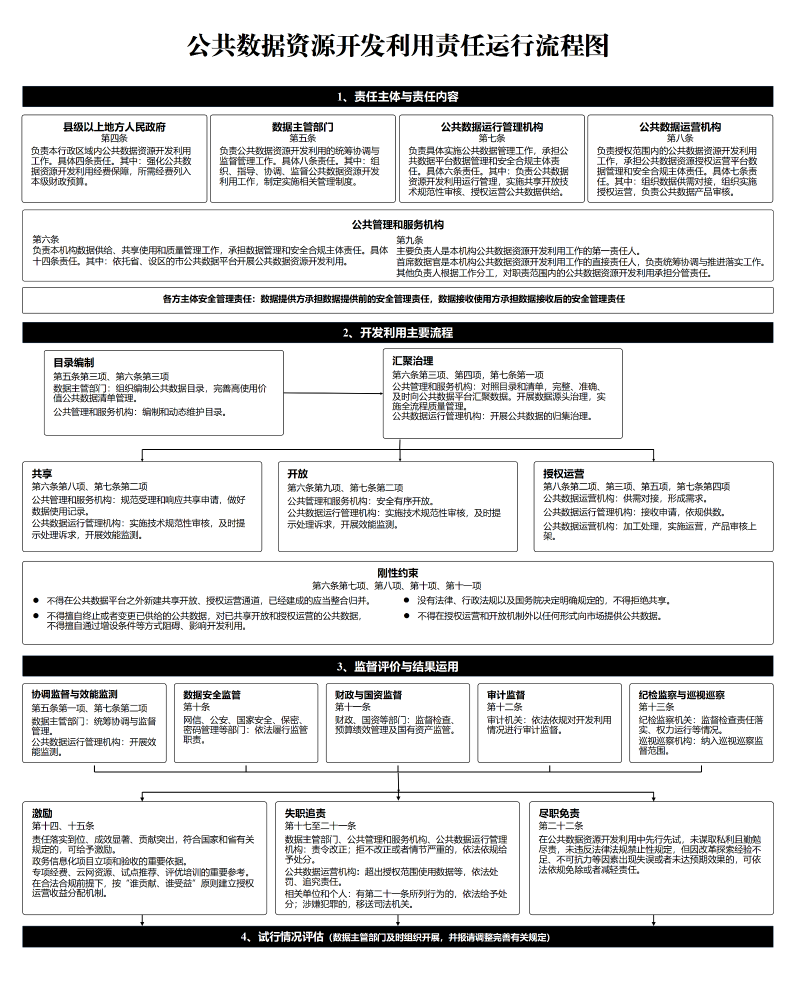
Annex to the Provisions, from the official text, in Chinese. DCC's English reading follows.
DCC’s English reading of the annex.
1. Responsible parties and the content of their responsibilities
- Local people’s governments at or above county level (Article 4): responsible for the work within the administrative area; four specific duties, including funding in the fiscal budget.
- Data administration department (Article 5): overall coordination, supervision and administration; eight specific duties.
- Public data operation-management institution (Article 7): carries out public data management and bears primary responsibility for the public data platform; six specific duties.
- Public data operating institution (Article 8): development and utilization within the scope of authorization, and primary responsibility for the authorized operation platform; seven specific duties.
- Public management and service institutions (Article 6): data supply, shared use and quality management; fourteen specific duties. Under Article 9, the principal person in charge is the first person responsible, the chief data officer is directly responsible, and other persons in charge are responsible for their portfolios.
- Security responsibility of all parties: the data provider is responsible before the data is provided; the data recipient and user is responsible after it is received.
2. The main process of development and utilization
- Catalogue compilation (Article 5(3), Article 6(3)), then pooling and governance (Article 6(3) and (4), Article 7(1)).
- Three outlets: sharing (Article 6(8), Article 7(2)), opening (Article 6(9), Article 7(2)) and authorized operation (Article 8(2), (3) and (5), Article 7(4)).
- Rigid constraints (Article 6(7), (8), (10) and (11)): no new sharing, opening or authorized operation channels outside the public data platform, and existing ones to be merged; no refusal to share without an express basis in a law, administrative regulation or State Council decision; no unauthorized termination or alteration of public data already supplied, and no added conditions obstructing its use; no supply of public data to the market in any form outside the authorized operation and opening mechanisms.
3. Supervision, evaluation and the use of results
- Five lines of supervision: coordination, supervision and efficiency monitoring (Article 5(1), Article 7(2)); data security supervision (Article 10); fiscal and state-owned assets supervision (Article 11); audit supervision (Article 12); discipline inspection and inspection tours (Article 13).
- Three outcomes: incentives (Articles 14 and 15); accountability for dereliction of duty (Articles 17 to 21); exemption for due diligence (Article 22).
4. Assessment of the trial: to be organized by the data administration department in due course, with a report on adjusting and improving the relevant provisions.
Source: General Office of the Jiangsu Provincial People’s Government, as republished by the National Data Administration, November 21, 2026. Original (Chinese). DCC’s brief: Jiangsu Makes Public Data Supply a Duty.
— Not legal advice.