Editor’s Note — DCC.
This brief translates a practitioner’s guide published by 网安寻路人 on October 27, 2026. The post names no author; “we” below is the post’s authors. It reads two instruments DCC has translated in full: MOST’s Measures for the Ethical Review of Science and Technology (Trial) (2023, the “Sci-Tech Ethics Measures”), and MIIT’s Measures for the Ethics Review of and Services for Artificial Intelligence Science and Technology (Trial) (2026, the “AI Ethics Measures”). Statutory wording below follows DCC’s translations of the two Measures.
Three notes on the text. Dates: the AI Ethics Measures are dated March 20, 2026 and take effect “from the date of issuance”. MIIT published them on April 2, 2026, which is the date the authors give. Gaps: some numbered lists in the original skip items (for example (1) then (4)), and the Service Center table has two rows. They appear that way in the published post, and DCC has kept them as published. Figures: the post’s four charts are reproduced from the original, in Chinese, each followed by DCC’s English reading. DCC has also dropped the account’s list of past articles that opens the post.
AI science and technology ethics review has become a pressing topic for companies. In recent Hong Kong listing applications, most companies involved in the research, development, and application of algorithms and AI have received targeted regulatory inquiries on AI ethics review. AI ethics review involves several interlinked regulations and joint supervision by several departments, and the review itself is still at a pilot and exploratory stage. As a result, companies lack an overall picture of why the regime exists and how to comply with it. We put this piece together while working through those questions alongside companies, for shared discussion.
Quick questions, quick answers
1. Who is the competent authority for AI ethics review?
In practice, MIIT’s Department of Science and Technology. The pilot work on “specialized AI Science and Technology Ethics Review and Service Centers” shows that provincial departments of industry and information technology, of economy and information technology, and of science and technology may all act as the local competent authority. See Part II.
2. If a company has completed generative AI service filing (or registration) or algorithmic recommendation filing, does it still need AI ethics review?
If the filing or registration process lacks materials showing that ethics review was completed, AI ethics review is still required. And because such activities fall within the circumstances on the Re-Review List, the expert re-review procedure applies. See Parts III and VII.
3. Must a company set up an AI ethics committee?
No. The committee’s main duties are to build the system, accept applications, conduct the first review, judge whether the Re-Review List applies, supervise AI ethics activities, and receive complaints. The committee can also decide independently whether the simplified procedure applies.
The AI Ethics Measures also make clear that a responsible unit that has not set up a committee, or whose committee cannot meet the requirements of ethics review, may apply to the Service Center it has commissioned. So the committee is not mandatory. Where there is none, its duties, especially the first review, are performed by the Service Center. See Part IV.
4. How should the committee be built? Can an independent director sit on it?
Key points: at least 7 members, at least 1 of them from outside the unit. We do not recommend independent directors serving on the committee. See Part IV.
5. Who decides whether AI ethics review is needed?
The company itself. It should explain whether its AI scientific research, technology development, and similar activities may involve ethics risks in respects such as human dignity, public order, life and health, the ecological environment, and sustainable development, and state the basis for that judgment.
6. How is the first AI ethics review completed?
The person in charge of the AI activity initiates it by submitting to the unit’s AI ethics committee or a Service Center, which carries out the first review. In practice, a responsible unit can complete the first review through (1) its own AI ethics committee; (2) an AI ethics committee it forms itself with the help of a commissioned third-party consultancy; or (3) a commissioned local Service Center. See Part VI.
7. Which activities need expert re-review, and what is on the Re-Review List?
All the re-review circumstances in both the Sci-Tech Ethics Measures and the AI Ethics Measures must be considered together; see Part VII. Under the AI Ethics Measures alone, they are:
- research and development of human-machine fusion systems that have a strong influence on human subjective behavior, psychological and emotional states, and life and health (for example, emotional-companion systems and anthropomorphic interaction services);
- research and development of algorithmic models, applications, and systems having the capability to mobilize public opinion and guide social consciousness;
- research and development of highly autonomous automated decision-making systems oriented toward scenarios presenting safety or personal-health risks (for example, L3-and-above autonomous driving systems).
8. How is expert re-review done?
By an “expert re-review panel” formed by local or relevant industry competent authorities, or by a “specialized AI Science and Technology Ethics Review and Service Center”. No public material yet describes the expert re-review procedure itself. See Part VII.
9. What happens if AI ethics review is not completed?
The consequences come in three tiers (administrative penalty or other handling, civil liability, and criminal liability), and cross-reference provisions route them to the Law on Progress of Science and Technology, the Personal Information Protection Law, the Data Security Law, the Cybersecurity Law, and other laws. See Part VIII.
10. What must be registered on the National Science and Technology Ethics Management Information Registration Platform?
- the AI ethics committee, within 30 days of its establishment;
- activities on the Re-Review List;
- the committee’s annual work report and the implementation of Re-Review List activities, by March 31 each year.
11. What is the overall process, and how long does it take?
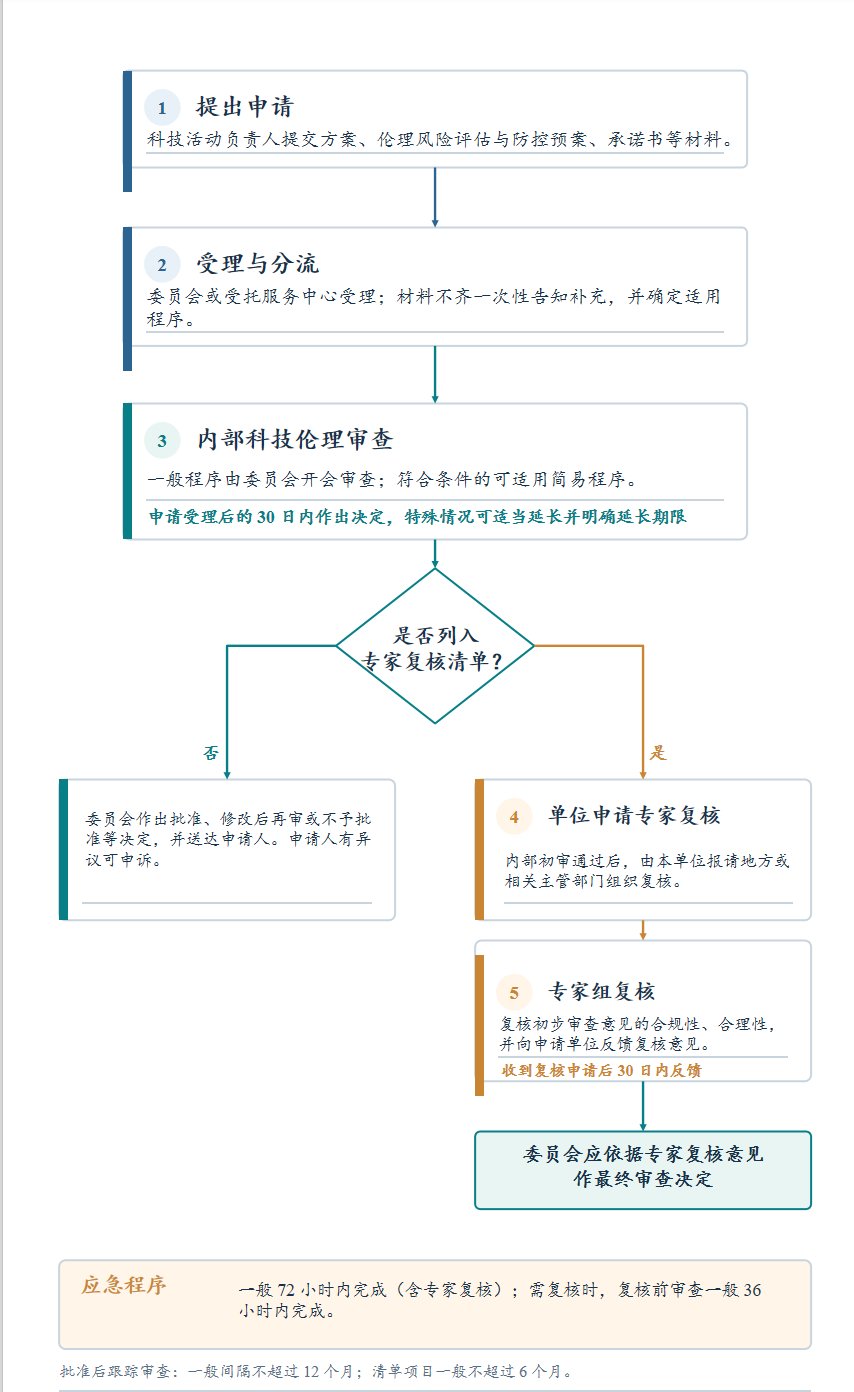
Chart from the original post, in Chinese. DCC's English reading follows.
DCC’s English reading of the flowchart:
- Application. The person in charge of the activity submits the plan, the ethics risk assessment and prevention-and-control plan, a letter of undertaking, and other materials.
- Acceptance and routing. The committee, or a commissioned Service Center, accepts the application. Missing materials are notified all at once, and the applicable procedure is set.
- Internal ethics review. Under the general procedure the committee meets to review; where conditions are met, the simplified procedure applies. A decision is due within 30 days of acceptance, extendable in special circumstances with the extension period specified.
- Is the activity on the Re-Review List?
- No: the committee decides to approve, require revision and resubmission, or not approve, and serves the decision on the applicant. The applicant may appeal.
- Yes: after the internal first review, the unit applies to the local or relevant competent authority to organize expert re-review. The panel reviews the compliance and reasonableness of the first-review opinion and returns its opinion within 30 days of receiving the application. The committee then makes the final review decision on the basis of the re-review opinion.
Emergency procedure: generally completed within 72 hours, including expert re-review. Where re-review is needed, the review before re-review is generally completed within 36 hours.
Follow-up review after approval: generally at intervals of no more than 12 months; no more than 6 months for activities on the List.
I. Where the requirement comes from
AI science and technology ethics review is the application and refinement, in the AI field, of the science and technology ethics review regime. As a unified concept, ethics review goes back to the Plan for Establishing the National Science and Technology Ethics Committee, adopted at the ninth meeting of the Central Commission for Comprehensively Deepening Reform in 2019. Its formal entry into normative documents is marked by Article 103 of the Law on Progress of Science and Technology as revised in 2021 (effective January 1, 2022).
In March 2022, the General Offices of the CPC Central Committee and the State Council issued the first national-level guidance on science and technology ethics governance, the Opinions on Strengthening the Ethical Governance of Science and Technology [link 1]. They called for “improving the rules and procedures for science and technology ethics review, improving the establishment standards and registration system for science and technology ethics (review) committees, and establishing an expert re-review mechanism for ethics review results”. The dedicated document on ethics review is the Measures for the Ethical Review of Science and Technology (Trial), issued in 2023 [link 2] (the “Sci-Tech Ethics Measures”).
AI ethics review has also long been on the policy agenda. In 2017, the State Council’s New Generation Artificial Intelligence Development Plan [link 3] called for formulating AI ethics norms and assessing potential harms. In September 2021, Article 13 of the Ethical Norms for New Generation Artificial Intelligence [link 4] expressly required “strengthening ethics review” in data collection and algorithm development. The Sci-Tech Ethics Measures, issued on September 7, 2023 [link 5] and effective December 1, 2023, brought AI activities and algorithms, models, and systems into the general review framework. The administrative normative document dedicated to AI, the Measures for the Ethics Review of and Services for Artificial Intelligence Science and Technology (Trial) [link 6] (the “AI Ethics Measures”), was released and took effect on April 2, 2026.
II. The regulatory framework
AI ethics review follows a “one body, two wings” pattern. In current practice, the department directing the work is MIIT’s Department of Science and Technology.
- One wing (the science-and-technology and MIIT track). MOST and MIIT regulate mainly through the Sci-Tech Ethics Measures [link 7] and the AI Ethics Measures [link 8].
- The other wing (the cyberspace track). The CAC and other departments embed a “science and technology ethics review” duty in sector rules on algorithms, deep synthesis, and generative AI. The Algorithmic Recommendation Provisions and the Deep Synthesis Provisions both require service providers to fulfil the responsibility for science and technology ethics review. Article 20 of the amended Cybersecurity Law, effective January 1, 2026, writes AI ethics norms into law for the first time (see DCC’s brief on the 2025 CSL amendment).
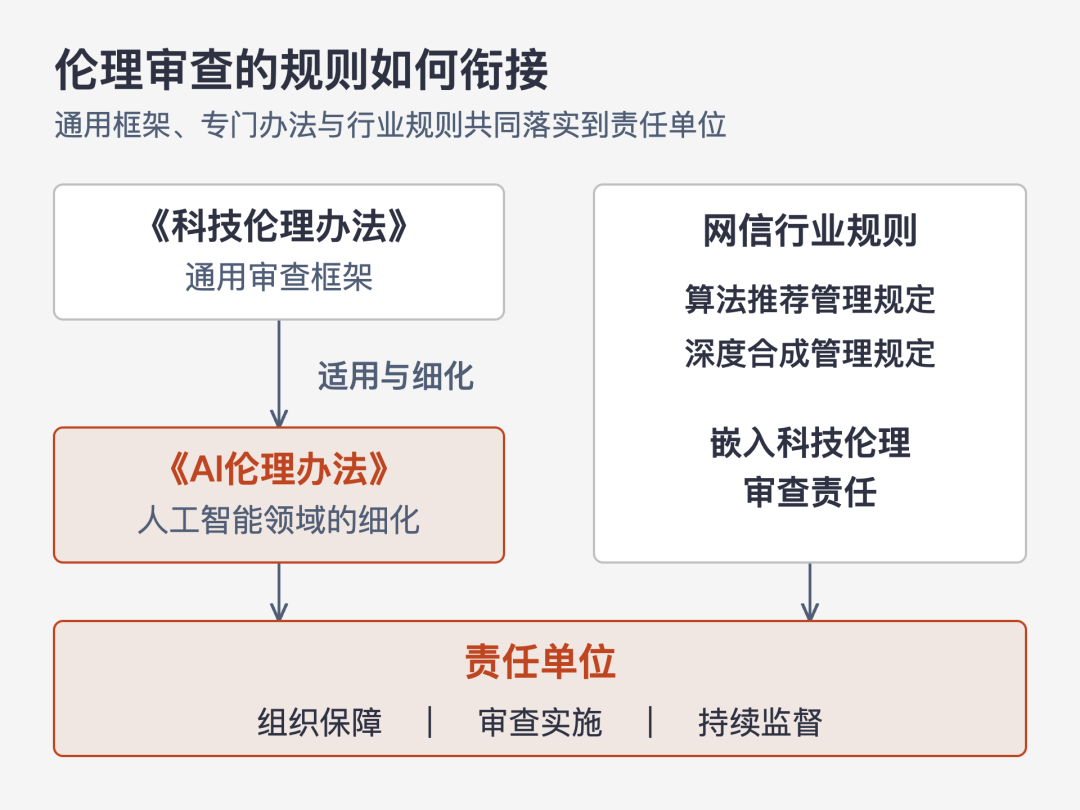
Chart from the original post, in Chinese. DCC's English reading follows.
DCC’s English reading. The Sci-Tech Ethics Measures supply the general review framework, which the AI Ethics Measures apply and refine for the AI field. The CAC’s sector rules (the Algorithmic Recommendation Provisions and the Deep Synthesis Provisions) embed a responsibility for ethics review. Both lines land on the responsible unit, which provides organizational safeguards, conducts the review, and supervises on an ongoing basis.
III. Scope of review
Which activities need AI ethics review has to be worked out by reading the Sci-Tech Ethics Measures, the AI Ethics Measures, the Algorithmic Recommendation Provisions, and the Deep Synthesis Provisions together (see Table 1). Under the current rules it is hard to judge which AI activities count as AI scientific research and technology development “that may raise science and technology ethics risks and challenges in respects such as human dignity, public order, life and health, the ecological environment, and sustainable development”.
Note well, though: algorithmic recommendation service providers, deep synthesis service providers, and their large-model counterparts, the AI filers and AI registrants, all already fall within the range of entities responsible for AI ethics review. (The AI filing and registration duties in fact derive from the Algorithmic Recommendation Provisions.)
Article 26 of the AI Ethics Measures provides: “Where an artificial intelligence science and technology activity is already subject to regulatory measures such as registration, filing, or administrative approval in respects such as deep synthesis, algorithmic recommendation, or the administration of generative artificial intelligence services, and compliance with science and technology ethics requirements has been made a condition of approval or a matter of regulatory content therein, expert re-review need no longer be carried out.”
On our reading of Article 26, an algorithmic recommendation service provider, deep synthesis service provider, AI filer, or AI registrant within the scope of the AI Ethics Measures must complete expert re-review if ethics was not approved in its filing or registration materials. In the client materials we have reviewed, we have seen almost no dedicated review or approval of ethics in algorithm filing, AI registration, or AI filing materials. That means algorithmic recommendation service providers, deep synthesis service providers, AI filers, and AI registrants almost all need to complete ethics review, including the expert re-review procedure, whether or not they have completed filing or registration.
Table 1
| Document and provision | What it provides |
|---|---|
| Sci-Tech Ethics Measures, Art 2 | Defines the activities requiring ethics review by enumeration plus a catch-all: (1) activities involving humans as research participants, including research that takes humans as the subjects of testing, surveys, or observation, and activities using human biological samples, personal information data, and the like; (2) activities involving laboratory animals; (3) activities not directly involving humans or laboratory animals but that may raise ethics risks and challenges in respects such as life and health, the ecological environment, public order, and sustainable development; (4) other activities requiring ethics review under laws, administrative regulations, and relevant national provisions. |
| AI Ethics Measures, Art 2 | The following AI activities carried out in China require AI ethics review: (a) AI scientific research, technology development, and similar activities that may raise science and technology ethics risks and challenges in respects such as human dignity, public order, life and health, the ecological environment, and sustainable development; (b) other activities requiring AI ethics review under laws, administrative regulations, and relevant national provisions. |
| Algorithmic Recommendation Provisions, Art 7 | Algorithmic recommendation service providers shall fulfil their primary responsibility for algorithm security and establish and improve management systems and technical measures for algorithm mechanism review, science and technology ethics review, user registration, information release review, data security and personal information protection, and more. |
| Deep Synthesis Provisions, Art 7 | Deep synthesis service providers shall fulfil their primary responsibility for information security, establish and improve management systems for user registration, algorithm mechanism review, science and technology ethics review, information release review, data security, personal information protection, anti-telecom and online fraud, emergency response, and more, and have secure and controllable technical safeguards. |
IV. Setting up and registering the AI ethics committee
Under Article 9 of the AI Ethics Measures, institutions of higher learning, scientific research institutions, medical and health institutions, enterprises, and other entities engaged in AI activities are the responsible units for managing AI ethics review within their organizations. They are to set up an AI ethics committee in accordance with Article 4 of the Sci-Tech Ethics Measures. Under that Article 4, units engaged in life sciences, medicine, AI, and similar activities whose research involves sensitive fields of science and technology ethics [note 1] shall set up a science and technology ethics (review) committee.
Entities whose activities require AI ethics review are therefore responsible units, and should set up an AI ethics committee (the “committee”) as required. The responsible unit should provide the staff, office space, funding, and other conditions the committee needs to perform its duties, and take effective measures to ensure the committee conducts ethics review independently.
The committee is the key body through which a responsible unit implements the two Measures. It is the “first checkpoint of responsibility”, conducting the first review of the AI activities the unit plans to carry out. Its members therefore need professional backgrounds and must include people from outside the unit. The committee must be registered, and it must prepare an annual work report and register it on the National Science and Technology Ethics Management Information Registration Platform.
Note, however, that Article 12 of the AI Ethics Measures expressly allows a responsible unit that has not set up a committee, or whose committee cannot meet the requirements of ethics review, to apply to the Service Center it has commissioned. On our reading, then, an AI ethics committee is not mandatory; if there is none, the review work can be commissioned to a Service Center.
1. Composition
- At least 7 members, with one chair and several vice-chairs.
- Members are experts with professional backgrounds in AI technology, application, ethics, law, and related fields. They must include members of different genders and members from outside the unit; in ethnic autonomous areas, members familiar with local conditions.
- Terms of no more than 5 years, renewable.
In practice, these are all the qualification requirements the rules set for committee members. The responsible unit judges for itself what counts as a relevant professional background. Drawing on questions companies have raised, we highlight two points:
- “Members from outside the unit” are best understood as independent individuals with no connection to the unit or its affiliates, not simply people who are not employed by the unit.
- We do not recommend independent directors serving on the committee. An independent director who joins a management-level ethics review body as an “external member” may cross the red line in Article 2 of the Administrative Measures for Independent Directors of Listed Companies, which requires that they “hold no position in the listed company other than director”, and so impair their independence.
2. The committee’s charter
The committee should adopt an AI Science and Technology Ethics Committee Charter as the basic rules for its internal organization and activities. In form it can follow a company’s articles of association; in content it generally covers general provisions, organization, scope of duties, and review procedures. The charter is the committee’s standard of conduct and must be adopted.
3. Registration
Within 30 days of setting up the committee, the responsible unit should register it through the National Science and Technology Ethics Management Information Registration Platform (the National Science and Technology Management Information System Public Service Platform [link 9]). Registration covers the committee’s composition, charter, working rules, and the like, and must be updated promptly when they change.
Note also that the committee must complete an annual work report and register it on the same platform.
V. Building the AI ethics governance system
The two Measures scatter their requirements for an AI ethics governance system. On our reading, they can be consolidated into a single, stand-alone AI Science and Technology Ethics Governance System, or follow whatever guidance MIIT and MOST issue in due course. The contents and requirements include, but are not limited to, the following.
1. AI Science and Technology Ethics Risk Assessment Measures
(1) Basis: Article 9 of the Sci-Tech Ethics Measures.
(4) Function: guides the unit’s technical staff in assessing potential ethics risks. Where the assessment finds that an AI activity requires AI ethics review, the person in charge of the activity should apply to the committee for review.
2. AI Science and Technology Ethics Emergency Review System
(1) Basis: Article 35 of the Sci-Tech Ethics Measures; Article 27 of the AI Ethics Measures.
(5) Function: sets out the emergency review process and standard operating procedures for public emergencies and other urgent situations.
3. Other requirements
Under Article 6 of the Sci-Tech Ethics Measures, the committee should establish and improve rules and working procedures for review, supervision, confidentiality, and records management, and a conflict-of-interest management mechanism. These should include procedures for the simplified procedure, especially where the responsible unit may use it, so that ethics review is compliant, transparent, and traceable.
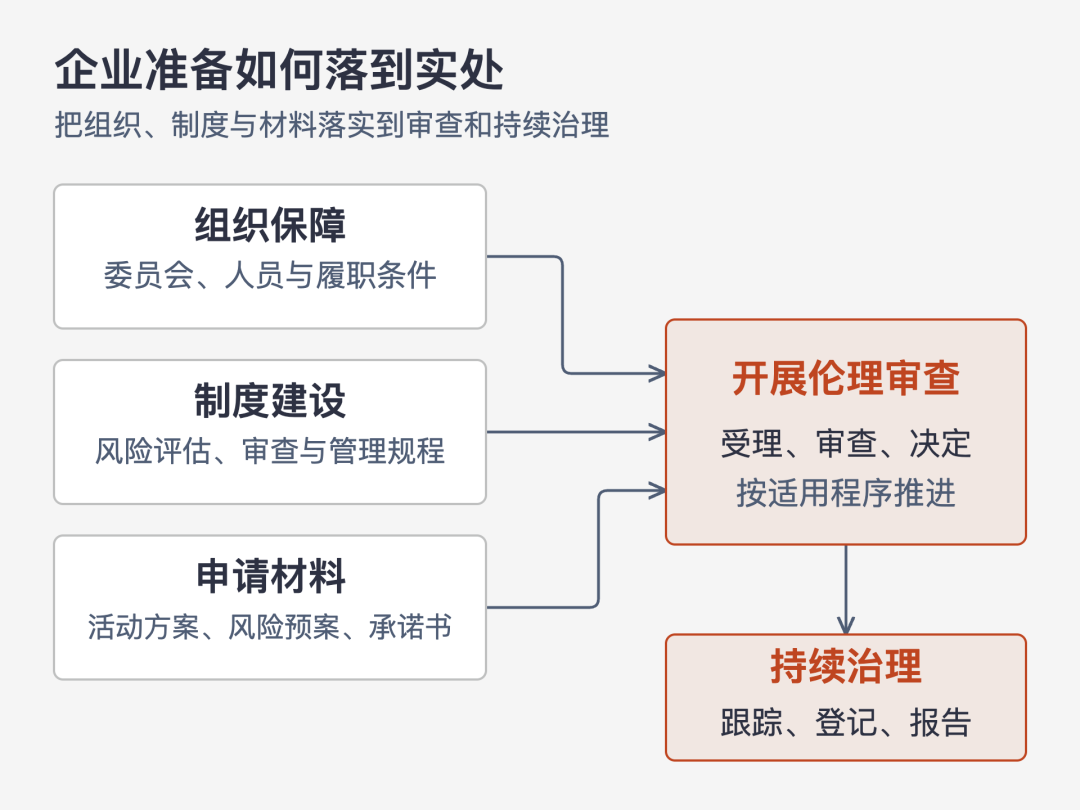
Chart from the original post, in Chinese. DCC's English reading follows.
DCC’s English reading. Three inputs feed the review: organizational safeguards (the committee, staffing, and the conditions to perform its duties), system building (risk assessment, and review and management procedures), and application materials (the activity plan, the risk plan, and the letter of undertaking). These lead to conducting ethics review (acceptance, review, and decision, under the applicable procedure), followed by ongoing governance (follow-up review, registration, and reporting).
VI. The review process: first review by the internal committee
The unit’s technical staff assess the ethics risks of AI activities under the unit’s AI Science and Technology Ethics Risk Assessment Measures. Where the assessment finds that an AI activity requires AI ethics review, the person in charge of the activity should apply to the committee and submit application materials as required. Note that AI ethics review is an internal self-review by the responsible unit. The unit can do it alone, or hire a third-party consultancy to help it with the benefit of its experience. The unit can also apply to a Service Center (see Part VII) to carry out the review.
1. Preparing the application materials
Whichever procedure applies, the responsible unit must prepare application materials to start the review. They mainly include:
(1) the AI activity plan, including the research background, purpose, and plan; the lawful qualification materials, personnel, and funding sources of the institutions involved; the algorithmic mechanisms and principles to be adopted; the sources of data and how they are obtained; testing and evaluation methods; the software and hardware products to be formed; and the intended application fields and applicable populations;
(6) the ethics risk assessment of the AI activity, and the prevention, control, and emergency response plans, including an assessment of the potential ethics risks of the AI technology’s intended application, monitoring and early-warning measures for ethics risks, and prevention and control plans for possible ethics risks;
(7) a letter of undertaking to comply with AI ethics, research integrity, and other requirements.
[DCC: items (2)–(5) are omitted in the original post. The full list is in Article 12 of the AI Ethics Measures.]
2. Submission to the committee
(1) Acceptance or rejection. On the basis of the application materials, the committee decides whether to accept the application and notifies the applicant. If it accepts, it sets the applicable procedure (general, simplified, or emergency) according to the likelihood and degree of ethics risk, any urgency, and so on, and conducts the review offline or online as each procedure requires. If materials are incomplete, it tells the applicant everything that needs to be supplemented in a single notice.
(2) The simplified procedure. If the committee considers that the conditions for the simplified procedure in Article 19 of the AI Ethics Measures are met, it may use that procedure for the first review. The committee should set working rules and a follow-up frequency for simplified-procedure review. Simplified-procedure review is carried out by two or more members designated by the committee chair (here, on our reading, they need not include an external member). The committee decides whether the simplified procedure is used. Where the responsible unit may use it, working rules and a follow-up frequency for it should be written into the AI ethics governance system.
The simplified procedure may apply where:
- a) the likelihood and degree of ethics risk in the AI activity are no higher than the ordinary risks encountered in daily life;
- b) an approved AI activity plan is revised in minor respects without increasing the risk–benefit ratio;
- c) it is a follow-up review of an AI activity with no major adjustments since the previous review.
The simplified procedure ends, and the general procedure applies instead, where during the review a negative review opinion arises, there are doubts about the matters under review, members disagree, or similar.
(3) The review decision. The committee should decide within 30 days of accepting the application whether to approve, require revision and resubmission, or not approve. The period may be extended as appropriate in complex cases or where materials must be supplemented or corrected, with the extension period specified.
Where revision is required or approval is refused, the committee should give suggestions for revision or reasons. An applicant who objects should appeal to the committee within 3 working days of service of the decision. If the grounds for appeal are sufficient, the committee should make a new decision within 7 working days.
The person in charge of the AI activity should promptly identify changes in ethics risk and report them to the committee. The committee conducts follow-up review of approved AI activities to stay on top of changes in ethics risk, and may decide to suspend or terminate an activity where necessary. Follow-up review mainly covers (1) implementation of, and adjustments to, the activity plan; (2) implementation of ethics risk prevention and control measures; (3) potential changes in ethics risk and any possible effect on the rights, interests, and safety of research participants; and (4) other matters requiring follow-up review. As follow-up review requires, the committee may ask the person in charge to submit relevant materials. Follow-up reviews are generally no more than 12 months apart, and no more than 6 months apart for activities on the Re-Review List.
VII. The review process: expert re-review
1. Activities requiring expert re-review
Under the AI Ethics Measures, the list of AI activities requiring expert re-review (the “Re-Review List”) currently has three categories, and will be adjusted dynamically as work requires:
- research and development of human-machine fusion systems that have a strong influence on human subjective behavior, psychological and emotional states, and life and health (for example, emotional-companion systems);
- research and development of algorithmic models, applications, and systems having the capability to mobilize public opinion and guide social consciousness (for example, AI and algorithms);
- research and development of highly autonomous automated decision-making systems oriented toward scenarios presenting safety or personal-health risks (for example, autonomous driving systems).
The AI Ethics Measures also provide that matters they do not address are governed by the Sci-Tech Ethics Measures and other relevant laws and regulations. The re-review list in the Sci-Tech Ethics Measures should therefore also be taken into account:
- research on synthesizing new species with a major impact on human life and health, values, the ecological environment, and the like;
- research introducing human stem cells into animal embryos or fetuses and then gestating them into individuals in an animal uterus;
- basic research altering the genetic material or patterns of inheritance of the nuclei of human germ cells, fertilized eggs, or pre-implantation embryonic cells;
- clinical research using invasive brain-computer interfaces to treat neurological and psychiatric disorders;
- research and development of human-machine fusion systems that have a strong influence on human subjective behavior, psychological and emotional states, and life and health;
- research and development of algorithmic models, applications, and systems having the capability to mobilize public opinion and guide social consciousness;
- research and development of highly autonomous automated decision-making systems oriented toward scenarios presenting safety or personal-health risks.
In addition, under both Measures a unit must register a listed activity on the National Science and Technology Ethics Management Information Registration Platform within 30 days of its ethics review approval. By March 31 each year it must also submit, through the platform, a report on the implementation of its listed AI activities in the previous year.
2. The expert re-review procedure
A company carrying out an AI activity on the Re-Review List, once the activity has passed the committee’s first review, applies through its unit to the local or relevant industry competent authority for expert re-review. The expert re-review panel (or Service Center) returns its re-review opinion to the applying unit within 30 days of receiving the application. The panel must give an opinion either agreeing or disagreeing, and the opinion requires the agreement of at least two-thirds of all the re-review experts. The committee then makes its ethics review decision on the basis of the expert re-review opinion.
Note that expert re-review can be carried out by two kinds of body:
- An “expert re-review panel”. The panel is formed by the local or relevant industry competent authority and consists of at least 5 members: peer experts of high academic standing in the field of the AI activity, plus experts in ethics, law, and related fields. A committee formed within the entity under review may not take part in the re-review of activities that it reviewed itself. The panel re-reviews the compliance, reasonableness, and other aspects of the first-review opinion.
- An “AI Science and Technology Ethics Review and Service Center”. Service Centers are set up by local authorities and relevant competent departments on the basis of relevant units, in light of actual circumstances, and local or competent authorities may commission a Service Center to carry out the re-review. Under the MIIT General Office’s Notice on Implementing the AI Science and Technology Ethics Review and Service Pilot Program [note 2] (工信厅科函〔2026〕199号, issued April 28, 2026, published May 9, 2026), ten provinces and municipalities (Beijing, Shanghai, Guangdong, Shandong, Tianjin, Sichuan, Jiangsu, Hubei, Hunan, and Zhejiang) are pilot locations actively preparing Service Centers. As of publication, public sources show the following progress. From the preparations, one can also see that the provincial departments mainly responsible for ethics review are those for industry and information technology, economy and information technology, and science and technology. Responsible units can use this when making inquiries:
| Region | Progress | Vehicle / mechanism | Status |
|---|---|---|---|
| Jiangsu | Unveiled June 26, 2026 | Based at the Mofan Road AI Innovation Block; guided by the provincial Department of Industry and Information Technology; Nanjing’s core vehicle for implementing the Pilot Program | In physical operation (the first in Jiangsu and the Yangtze River Delta) |
| Sichuan | September 1, 2026: the provincial Department of Economy and Information Technology and Department of Science and Technology jointly opened applications under an open-competition (“unveil the list, appoint the leader”) mechanism | Universities, research institutions, enterprises, and public institutions may apply alone or as consortia; experts must cover AI technology, industry application, ethics, and law | Selection stage (the first use of the open-competition mechanism nationwide) |
On the substance of expert re-review, there is as yet no other dedicated guidance. Among public materials on ethics review, Sichuan’s Working Rules for Expert Re-Review of Science and Technology Ethics (Trial) [link 10] [note 3] are a useful reference. Their annex, the Sichuan Science and Technology Ethics Expert Re-Review Form, shows the specific aspects a re-review panel looks at.
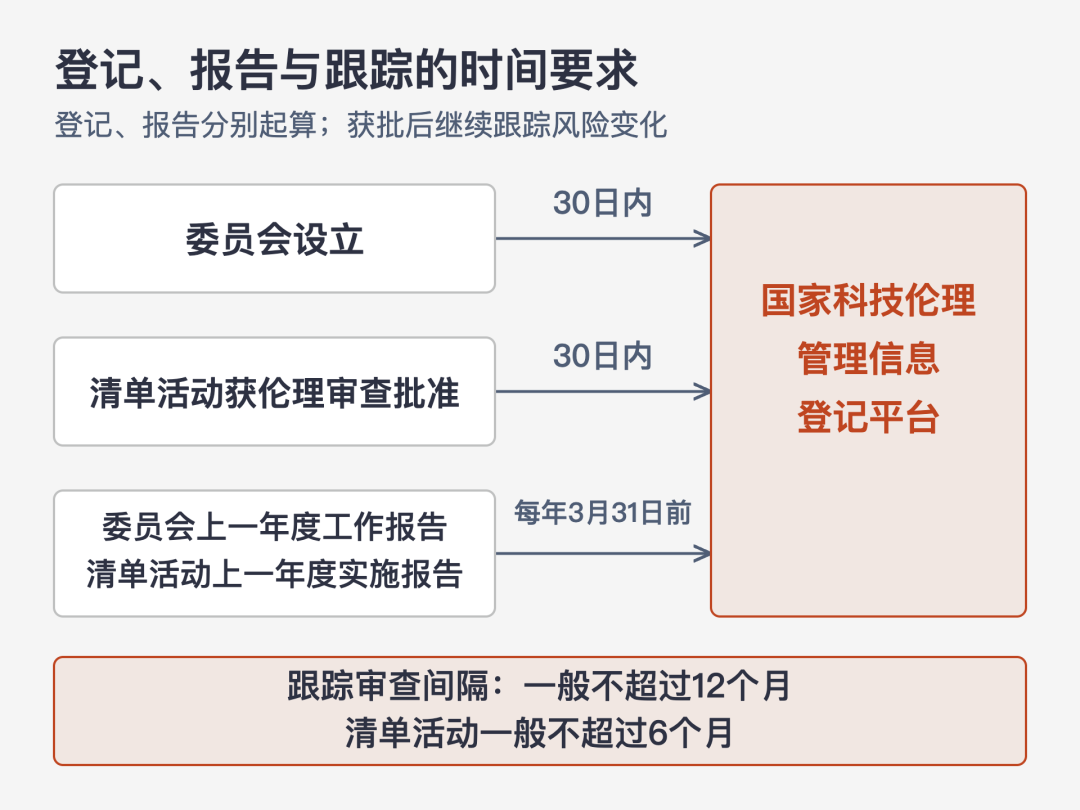
Chart from the original post, in Chinese. DCC's English reading follows.
DCC’s English reading. Registration and reporting run on separate clocks; after approval, the risk is tracked continuously.
| Event | Deadline | Where |
|---|---|---|
| Committee established | Within 30 days | National Science and Technology Ethics Management Information Registration Platform |
| Listed activity approved in ethics review | Within 30 days | Same platform |
| Committee’s prior-year work report; listed activities’ prior-year implementation report | By March 31 each year | Same platform |
Follow-up review: generally no more than 12 months apart; no more than 6 months apart for listed activities.
VIII. Consequences of breaching the ethics review requirements
1. The violations
Under the two Measures, breaches of the AI ethics review requirements include the following.
Direct violations under the Sci-Tech Ethics Measures:
- Art 47: obtaining ethics review approval by fraud, or forging or altering approval documents;
- Art 47: carrying out an activity under list management without passing ethics review and expert re-review as prescribed;
- Art 47: carrying out an activity without obtaining ethics review approval as prescribed;
- Art 47: carrying out an activity beyond the scope of the ethics review approval;
- Art 47: interfering with or obstructing ethics review;
- Art 48: (committees and members) using fraud to facilitate approval, favoritism, abuse of power, or dereliction of duty.
Review requirements under the Sci-Tech Ethics Measures:
- Art 12: an international cooperation activity within the scope of review may proceed only after passing the ethics review required in the countries of all cooperating parties;
- Arts 26 and 32: after the committee’s first review, a listed activity must go to the local or industry competent authority for organized expert re-review, and the committee decides on the basis of the re-review opinion;
- Art 39: no unit or individual may use an emergency as a reason to avoid ethics review or lower its standards;
- Art 19: in follow-up review, the committee may decide to suspend or terminate the activity.
Procedural constraints in the AI Ethics Measures themselves:
- Art 12: the person in charge of an AI activity within scope must apply to the unit’s AI ethics committee; where there is no committee or it is not competent, to a Service Center; a person without a unit must commission a qualified Service Center;
- Art 17: follow-up reviews are generally no more than 12 months apart, and the committee may decide to suspend or terminate where necessary;
- Art 30: registration and annual reporting duties (under Articles 43–45 of the Sci-Tech Ethics Measures).
2. The consequences
Under the “one body, two wings” structure, failing to complete AI ethics review triggers linked enforcement under several laws and regulations.
(1) The Sci-Tech Ethics Measures, directly and by cross-reference. Article 35(2) of the AI Ethics Measures hands matters they do not address to the Sci-Tech Ethics Measures and other relevant laws and regulations. The three-tier consequences in Article 47 of the Sci-Tech Ethics Measures (administrative penalty or other handling, civil liability, and criminal liability) therefore apply where AI activities are carried out without the review required by law. Table 2 sets out the provision.
Table 2
| Document and provision | What it provides |
|---|---|
| Sci-Tech Ethics Measures, Art 47 | Where a unit undertaking a science and technology activity or science and technology personnel violate these Measures in any of the following ways, the body with jurisdiction shall impose penalties or take action in accordance with laws, administrative regulations, and relevant provisions; where property loss or other harm is caused, civil liability shall be borne in accordance with law; where a crime is constituted, criminal liability shall be pursued in accordance with law: (1) obtaining ethics review approval by fraud, or forging or altering approval documents; (2) carrying out an activity under list management without passing ethics review and expert re-review as prescribed; (3) carrying out an activity without obtaining ethics review approval as prescribed; (4) carrying out an activity beyond the scope of the ethics review approval; (5) interfering with or obstructing ethics review; (6) other acts in violation of these Measures. |
The administrative liability for ethics violations is routed mainly to the Law on Progress of Science and Technology. Its relevant provisions are set out in Table 3.
Table 3
| Provision | What it provides |
|---|---|
| Law on Progress of Science and Technology, Art 107 | Prohibits R&D and application activities that violate research integrity or science and technology ethics. Serious violations of the rules governing science and technology activities are entered in the database of serious breaches of research integrity. |
| Law on Progress of Science and Technology, Art 112(1) | For R&D and application activities that violate science and technology ethics: the unit or competent department orders correction. Where public funds were received or there are illegal gains, it terminates or revokes the activity, recovers the public funds, and confiscates the illegal gains. In serious cases, the violation is made public, administrative penalties and sanctions are imposed, and the violator is barred for a period from undertaking or participating in publicly funded activities and from applying for related administrative licenses. The persons directly in charge and other directly responsible persons receive administrative penalties and sanctions in accordance with law. |
| Law on Progress of Science and Technology, Art 113 | For violations of the rules governing science and technology activities: an order to correct within a time limit, and possible recovery of public funds, a warning or public criticism, suspension of funding, or termination or revocation of the publicly funded activity. In serious cases, a bar for a period on undertaking or participating in publicly funded activities, and removal of management qualifications for a period. |
(2) The AI Ethics Measures, directly and by cross-reference. Under Article 32 of the AI Ethics Measures, a violation of the Measures in the course of an AI activity or AI ethics work is investigated and penalized under the Cybersecurity Law, the Data Security Law, the Personal Information Protection Law, the Law on Progress of Science and Technology, and other laws, regulations, and relevant provisions.
Notes
- There is as yet no express rule on what counts as a “sensitive field of science and technology ethics”. Following the regulatory logic of the Sci-Tech Ethics Measures and the AI Ethics Measures, it should mean the business fields covered by the circumstances to which the two Measures apply.
- https://www.miit.gov.cn/zwgk/zcwj/wjfb/tz/art/2026/art_353d0d2a06ab4cebbfd53f97aec4ae24.html
- https://www.sc.gov.cn/scszfgb/1402/2642/2654/202607/MIT114399.shtml
Reference links
- Opinions on Strengthening the Ethical Governance of Science and Technology: https://www.gov.cn/zhengce/2022-03/20/content_5680105.htm
- Measures for the Ethical Review of Science and Technology (Trial): https://www.gov.cn/zhengce/zhengceku/202310/content_6908045.htm
- New Generation Artificial Intelligence Development Plan: https://app.www.gov.cn/govdata/gov/201707/20/408540/article.html
- Ethical Norms for New Generation Artificial Intelligence: https://www.most.gov.cn/kjbgz/202109/t20210926_177063.html
- Measures for the Ethical Review of Science and Technology (Trial): https://www.gov.cn/zhengce/zhengceku/202310/content_6908045.htm
- Measures for the Ethics Review of and Services for Artificial Intelligence Science and Technology (Trial): https://wap.miit.gov.cn/zwgk/zcwj/wjfb/tz/art/2026/art_c5039010f5d24e1593152a9355f9c51c.html
- National Science and Technology Management Information System Public Service Platform: https://service.most.gov.cn/index/
- Sichuan Working Rules for Expert Re-Review of Science and Technology Ethics (Trial): https://www.sc.gov.cn/scszfgb/1402/2642/2654/202607/MIT114399.shtml
— 网安寻路人, 人工智能科技伦理审查,企业准备好了吗? (Are Companies Ready for AI Science and Technology Ethics Review?), October 27, 2026. Original (Chinese).
— Not legal advice.