Editor’s Note — DCC.
This is the companion to DCC’s brief on the release of 工信厅信管〔2026〕42号: MIIT Puts AI-Agent Phones Under Network Access Management. The Notice itself is translated in full on the law page, MIIT Agent Terminal Notice.
An official interpretation (政策解读) is not a legal source, but it is the issuing body’s statement of purpose, and regulators and testing institutions read the instrument through it. The translation below is complete. DCC’s notes come after it and are marked as DCC’s.
Policy interpretation of the Notice on Strengthening the Network Access Management of Agent Terminal Equipment
Recently, the Ministry of Industry and Information Technology issued the Notice on Strengthening the Network Access Management of Agent Terminal Equipment (the “Notice”). The relevant content is interpreted as follows.
1. What are the background and purpose of the Notice?
The Party Central Committee and the State Council attach great importance to work on new-generation smart terminals and AI agents (智能体). The Outline of the 15th Five-Year Plan for National Economic and Social Development of the People’s Republic of China expressly provides for the development of AI phones and other new-generation smart terminals. The Notice is a practical step in carrying out the decisions and arrangements of the Party Central Committee and the State Council, and an important measure in response to the needs of industry. By improving the regulatory rules for agent terminals and strengthening the management of agent terminals, it provides an inclusive and prudent environment for the development of new business forms and new models of agent terminals, and guides AI technology to be “used by people, serving people, and controlled by people”.
2. What are the main contents of the Notice?
The Notice has four main parts.
First, promoting agent adaptation. It requires agents to strengthen adaptation verification with terminal devices, to strengthen permission invocation and communication capability, and to further improve management in respect of the network access testing mechanism, network and data security, and other matters.
Second, strengthening the network access management of agent terminals. Agent adaptation verification and risk assessment are to be carried out within network access management, and the requirements for matters subject to special provisions are to be refined.
Third, strengthening the management of live-network upgrades. Where a live-network upgrade is carried out by over-the-air (OTA) update push or other means, a live-network upgrade plan is to be drawn up, and the service is to be provided to users after expert assessment and a solicitation of opinions.
Fourth, improving the distribution management mechanism. App developers are to be brought to declare whether they consent to invocation by agents, and users are to be provided with download and installation services for agents compatible with their device model.
3. What positive role does the Notice play in promoting the development of agent terminals?
The Notice gives equal weight to encouraging innovation and to safety and regulation.
First, it implements the “AI + terminals” (人工智能+终端) action plan. It establishes a full-chain system of rules covering adaptation verification, network access testing, live-network upgrades and distribution management, creates a sound institutional environment for market entities to carry out technical research and development and to bring products to market, and promotes the innovative development of AI phones and other new-generation smart terminals.
Second, it safeguards users’ lawful rights and interests. It restrains conduct such as forcible invocation by agents and installation on incompatible devices, gives effect to terminal users’ right to know and right to choose when using agents, guards against all kinds of security risks, effectively protects users’ lawful rights and interests, strengthens trust in on-device agents, and further releases consumption in the smart terminal market.
Third, it optimizes the ecosystem of industrial coordination. It optimizes and regulates the links of terminal production, agent development and app distribution, builds a system of cooperation among terminal hardware, pre-installed agents and third-party apps, and promotes the formation of an orderly and secure ecosystem of industrial coordination.
4. What safeguard measures does the Notice adopt?
The Notice has three safeguard measures.
First, strengthening supervision and administration. The Ministry of Industry and Information Technology and the communications administrations of the provinces, autonomous regions and municipalities directly under the Central Government are responsible for organization, coordination, supervision and inspection.
Second, reinforcing the implementation of responsibilities. All relevant entities shall earnestly perform their primary responsibility, set clear objectives, refine the division of work, strengthen management and technical support, and strictly implement each task.
Third, consolidating capacity building. The China Academy of Information and Communications Technology (CAICT) and relevant testing institutions are to improve their adaptation verification capability, build an adaptation filing database (适配备案库) of agent versions and terminal models, accelerate the development of adaptation-related standards, and raise the level of innovation in terminals and agents.
The one-chart explainer
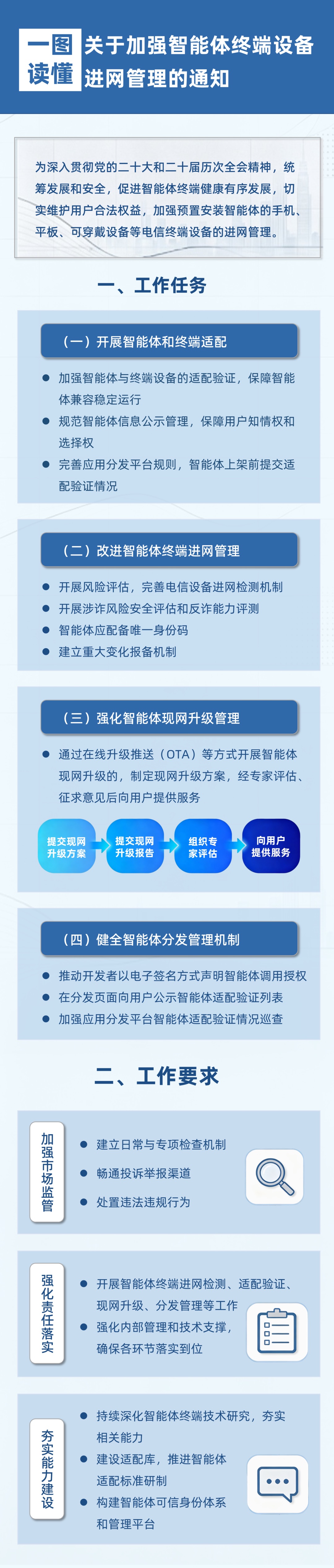
Chart from the original post, in Chinese. DCC's English reading follows.
DCC’s English reading.
Header. To strengthen the network access management of telecommunications terminal devices, such as mobile phones, tablets and wearable devices, on which an agent is pre-installed.
I. Work tasks
(1) Carry out adaptation between agents and terminals
- Strengthen adaptation verification between agents and terminal devices, and safeguard the compatible and stable operation of agents.
- Standardize the public display of agent information, and safeguard users’ right to know and right to choose.
- Improve the rules of app distribution platforms; adaptation verification status is submitted before an agent is listed.
(2) Improve the network access management of agent terminals
- Carry out risk assessment, and improve the network access testing mechanism for telecommunications equipment.
- Carry out the fraud-related risk security assessment and the evaluation of anti-fraud capability.
- Agents shall be equipped with a unique identity code.
- Establish a mechanism for reporting major changes.
(3) Strengthen the management of live-network upgrades of agents
- Where a live-network upgrade of an agent is carried out by OTA update push or other means, draw up a live-network upgrade plan; the service is provided to users after expert assessment and a solicitation of opinions.
- Flow: submit the upgrade plan → submit the upgrade report → MIIT organizes an expert assessment → provide the service to users.
(4) Improve the distribution management mechanism for agents
- Bring developers to declare authorization for agent invocation by electronic signature.
- Display the agent adaptation verification list to users on the distribution page.
- Strengthen app distribution platforms’ patrol inspection of agent adaptation verification status.
II. Work requirements
- Establish routine and special inspection mechanisms; keep complaint and reporting channels open; deal with unlawful and non-compliant conduct.
- Carry out network access testing, adaptation verification, live-network upgrades and distribution management for agent terminals; strengthen internal management and technical support so that every link is carried through.
- Continue to deepen research on agent terminal technology and consolidate the relevant capabilities; build the adaptation database and advance adaptation standards for agents; build a trusted identity system and management platform for agents.
Three places where the interpretation says more than the Notice
DCC’s notes.
1. It names the mischief. The Notice says only that an agent “shall not forcibly invoke or call up” an app whose developer has not declared consent. Question 3 lists the conduct to be restrained as “forcible invocation by agents and installation on incompatible devices” and files both under user protection: the right to know and the right to choose. The app developer’s interest is not mentioned there. It appears under the third heading instead, as “a system of cooperation among terminal hardware, pre-installed agents and third-party apps”.
2. It calls the database a filing database. Part II (3) of the Notice speaks of an “adaptation database” (适配库) of agent versions and terminal models. Question 4 calls it an “adaptation filing database” (适配备案库) and places it with CAICT and “relevant testing institutions”. The Notice itself creates no filing (备案) duty for agents, so whether entry in the database will work as one is a point to watch in the standards that follow.
3. The chart turns item (3) into a sequence. The Notice lists the upgrade plan, the upgrade report and the expert assessment in one paragraph. The chart orders them as four steps and puts “provide the service to users” last. Neither document says what happens between the report and the assessment for devices that have already received the upgrade.
For how commentators read item (4), see 数据何规’s Does China’s Phone Agent Now Need Two Consents?.
— 工信微报 (MIIT), 四问+一图,读懂《关于加强智能体终端设备进网管理的通知》 (Four Questions and One Chart: Understanding the Notice on Strengthening the Network Access Management of Agent Terminal Equipment), November 6, 2026; source: MIIT Information and Communications Administration Bureau. Translated in full by DCC; the notes are DCC’s own. Original (Chinese).
— Not legal advice.