Editor’s Note — DCC.
This brief translates an essay published by 网安寻路人 on October 28, 2026. The post names no author; “we” below is the account’s author (公号君). Its subject is an engineering disclosure, not a Chinese rule: Meta’s October 27, 2026 description of PrivacyLib, the part of its privacy infrastructure that enforces rules at the data-access layer. But the essay is a reading of the Personal Information Protection Law. It asks how the PIPL’s purpose and minimum-necessity limits (Article 6), its legal bases (Article 13), and its split between entrusted processing (Article 21) and provision to another handler (Article 23) can actually hold when an AI agent decides its own execution path at runtime.
Descriptions of PrivacyLib, AgentLib, Policy Zones, and Agent Observability are the author’s reading of Meta’s materials, as are the references to the CaMeL architecture and the October 2026 preprint Can CaMeLs Talk?. DCC has not independently reviewed those sources. The five diagrams are reproduced from the original post, in Chinese, each followed by DCC’s English reading. DCC has dropped the account’s list of past articles on agents that opens the post. For DCC’s earlier pieces on agents and consent, see AI Agents and the Limits of Consent and the TC260 agent-deployment practice guide.
Suppose a user tells an agent: “Sort out last week’s travel expenses and submit the claim.” To do it, the agent has to read emails, extract receipts, check the itinerary, and then call the company’s expense system. For the user, it is one instruction. Inside the system, it unfolds into a chain of personal information processing. Which emails may be read, whether receipts need to go to an external model for processing, whether the resulting spending records can be saved to long-term memory: these are often not fixed before the task starts. They are settled step by step as the task runs.
That raises a direct, concrete question for personal information protection. When a task’s execution path has not yet unfolded, how should the boundaries of personal information processing be drawn? And while the path keeps changing, how do you make sure those boundaries stay effective?
On October 27, 2026, Meta publicly described PrivacyLib, part of its privacy infrastructure. The mechanism embeds the enforcement of privacy rules directly in the underlying data-access layer. Through AgentLib, it links an internal agent’s tool calls to the current session, so that downstream systems can decide in real time, from the call context and the data’s annotations, whether to let an operation through. On paths that have been integrated and have controls switched on, even a combination of tools the developer never anticipated must pass a compliance check as soon as it touches data access.
In our view, what makes this practice worth attention is that it offers a workable implementation path for a problem that usually stays at the level of principle. An agent can decide for itself how to plan its steps and finish the task, but its authority to process personal information has to be verified at every concrete data operation. In other words, an agent’s autonomy can extend to how it executes a task. It cannot extend, on its own, the purpose or scope of personal information processing.
I. Task authorization has to come down to specific processing acts
Go back to the expense claim. Permission to read the receipts for this trip is not permission to analyze the employee’s spending habits over the past year along the way. Permission to call a search tool is not permission to put the employee’s name, hotel, and spending details into a search query and send it out. Even where each tool is available on its own, using them in combination can create information flows that go beyond the task as given.
The gap arises because “tool permissions” and “personal information processing permissions” answer different questions. The first is about what the system can technically call. The second goes further: whose information, which information, for what purpose these capabilities may be used on, and to whom the results may go. So even when the same person uses the same tool, a change in the processing purpose or the recipient changes the conditions under which the operation is lawful and compliant.
Article 6 of the PIPL requires that personal information be processed for a clear and reasonable purpose, directly related to that purpose, and limited to the minimum scope of collection necessary. Article 13 requires a legal basis for every processing activity. Seen in an agent setting, “the user gave a task instruction”, “the current account can technically access the data”, and “the specific processing act has a legal basis” are three different questions, to be judged separately. An employee who says “help me analyze these customers” can start a business request. But the system cannot, on that sentence alone, hand customer data to a new external service provider or turn it to another line of business. At runtime, each operation should be tied to the legal basis that applies to it, and checked against that basis for notice, consent, and the other legal conditions.
So a key step in designing an agent is to turn the user’s task into processing boundaries the system can enforce. For the expense claim, the system should fix it as a specific person, a specific travel period, and the fields necessary for the claim, and allow submission only to the designated expense system. If an external model genuinely needs to help, the system should decide in advance what content that model provider may receive. These boundaries are set first by trusted business systems and permission mechanisms, and they are the yardstick for whether any later operation goes through. At runtime, the model can request to read or send data. It cannot, to get a request approved, change the task’s purpose settings mid-execution.
Does this mean every tool call needs a pop-up for the user to approve one by one? No. Operations within an already-defined purpose and scope can be checked and executed automatically and continuously by the underlying system under the existing rules. Additional, substantive review is needed only when the task genuinely requires a new processing purpose, a new recipient, or a wider scope of information. That way the user’s real decision runs through the whole task, without turning complex technical calls back into a long string of “consent” buttons that wear users out and that they cannot really judge.
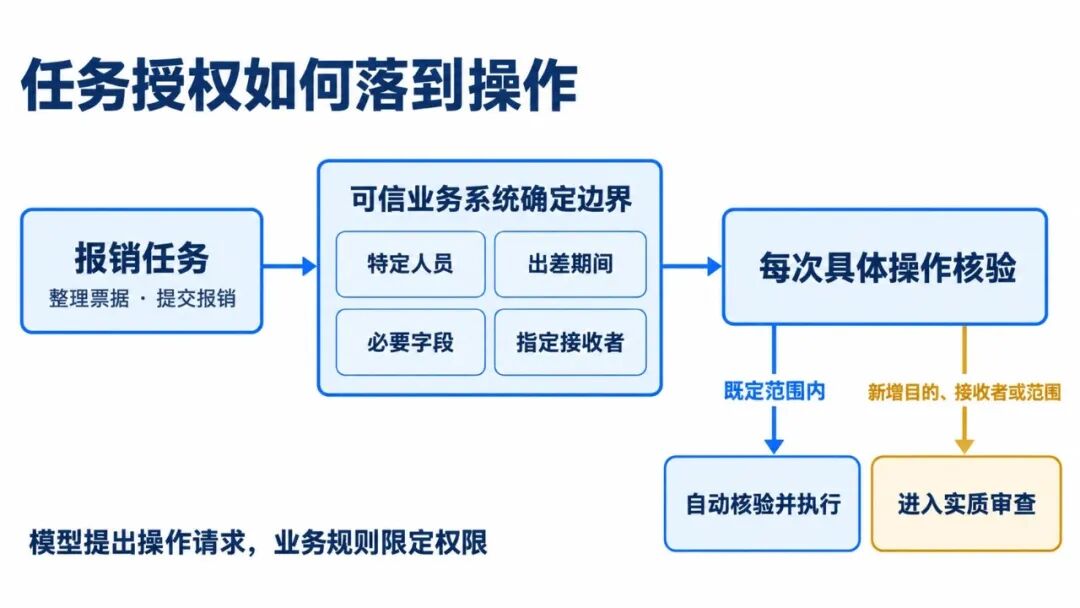
Diagram from the original post, in Chinese. DCC's English reading follows.
DCC’s English reading. The expense-claim task (sort receipts, submit the claim) goes to a trusted business system that sets the boundaries: specific person, travel period, necessary fields, designated recipient. Every concrete operation is then checked. Operations within the set scope are verified and executed automatically; a new purpose, recipient, or scope goes to substantive review. The model proposes operations; business rules limit what it may do.
II. Put the check where data actually flows
If processing boundaries have to be checked continuously at runtime, where should the check sit? PrivacyLib’s answer is to put a common checking mechanism in the data-access client libraries that backend services use. “Client” here does not mean an end-user application. It means the software libraries backend services use to reach databases, logging systems, and other underlying infrastructure. That position sits exactly at the gate through which data flows. It knows which data asset an operation will touch, and it can obtain the runtime context (the caller, the endpoint, the processing purpose). That makes it the best place to judge each concrete data operation.
In the runtime flow, once an agent makes a tool call, AgentLib first links that call to the corresponding agent session, and downstream services pass the context along the call chain. When the request reaches the data-access layer, PrivacyLib hands the operation, the call context, and the target data asset’s annotations to the relevant modules. Policy Zones enforce restrictions on purpose and information flow. Agent Observability records the session identifier, the tool calls, the access targets, and similar details, so that it can be established afterward which systems the data actually passed through. In short, “deciding whether to let it through” and “recording the access trail” are separate jobs in the system.
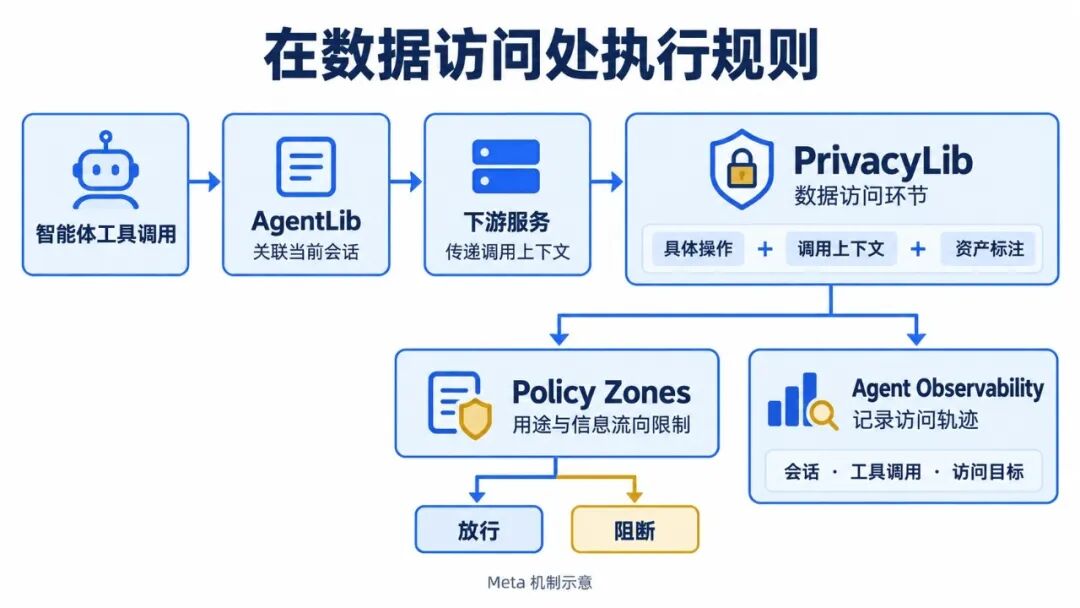
Diagram from the original post, in Chinese. DCC's English reading follows.
DCC’s English reading (illustration of Meta’s mechanism). Agent tool call → AgentLib (links the current session) → downstream services (pass the call context) → PrivacyLib at the data-access layer (operation + call context + asset annotation). PrivacyLib feeds two modules: Policy Zones (purpose and information-flow limits, which allow or block) and Agent Observability (records the access trail: session, tool calls, access targets).
Meta’s technical post uses the writing of message metadata as an example of how the decision happens. When the system is about to write data, it checks both whether the current call context is one in which message metadata may be used, and whether the target table carries the corresponding compliance annotation. With enforcement mode on, if either condition fails, the record is blocked before it is sent downstream. The design constrains both the data’s “current use” and its “onward destination”: even if processing is allowed at this step, the system still has to make sure the downstream target can carry the same protective restrictions.
This makes clear the pivotal role of data annotation in the whole mechanism. Annotations connect data assets to the privacy rules that apply to them, so different business services can understand and enforce the restrictions with consistent meaning. When Meta earlier introduced Policy Zones, it set out that the protections on downstream data should in principle be no weaker than those on its upstream source, and it put the creation, association, and removal of annotations under dedicated governance. Protective conditions can thus follow information all the way downstream. A caller cannot erase an existing purpose restriction simply by storing the data in another table or deleting a label.
Putting rule checks at the actual point of data access also answers, at the level of architecture, the problem that an agent’s execution path is hard to foresee. In a complex task, the agent’s combination of tools can keep changing. But however the path shifts, any read, write to storage, or request to another service eventually has to pass through a specific underlying interface. PrivacyLib maps read and write operations across heterogeneous systems onto a common policy-enforcement model, so new protection rules can reuse existing checkpoints. For supported direct remote procedure call (RPC) paths, verification at a lower-level boundary adds further coverage.
The lesson for agent compliance design is clear. Make every path that actually produces a data-processing effect go through a single check, and decide strictly by the processing purpose, data scope, and recipient conditions fixed in advance. Then even if untrusted external text induces the model, through prompt injection or otherwise, to propose a new out-of-bounds operation, the model does not thereby gain the authority to change the underlying verification conditions. The model chooses the next business action; the enforcement layer verifies whether that action crosses the legal boundaries of personal information processing. The two have separate permissions and clear, separate jobs.
III. After information is processed, its original limits must carry over
Once personal information enters an agent workflow, it often changes form. A few original receipts become an expense summary. A string of emails is condensed into a description of a person. Everyday chat logs are turned into high-dimensional vectors and stored in long-term memory. The question follows: after this processing, do the original purpose restrictions still apply?
If the control system only recognizes original files or original tables, it leaves an obvious loophole. Say the rules forbid sending original receipts to an external search service. After reading the receipts, the agent can simply restate the employee’s name, travel route, and spending, and send that as a search query. On the surface, the file name and wording have changed; the personal information, and its effect on the individual’s rights and interests, are still there. More importantly, the moment the agent writes the summary into the search parameters and sends the request, the data has already gone to the external service. Filtering content only when the final answer is generated for the user cannot undo a non-compliant transfer that has already happened.
So an agent system designed along the lines of Policy Zones should carry the restrictions over onto derived content as the data is processed. A practical starting point is for outputs during a task to keep, by default, the provenance labels and use conditions of the inputs. If the business needs more flexibility in later use, tracking can be made more granular, identifying which fields or computed results in an output actually depend on which restricted sources. The systems that handle text summaries, vector databases, and long-term memory must, in turn, be able to read these attached conditions and enforce them strictly whenever the derived content is called, retrieved, or delivered externally.
Security research on the CaMeL architecture offers a useful implementation reference here. It uses an interpreter that sits outside the model itself to maintain, for each runtime data variable, metadata on its provenance and who may read it. It propagates dependencies automatically as computation proceeds and enforces security policy before every tool call. The mechanism shows that “in what form the model uses the data” and “to whom the data may then be given” can be separated in a system and judged separately.
Normatively, processed content also calls for a further distinction between two situations. In the first, the original personal information has only changed its wording or medium; the existing protections must be maintained and fully inherited. In the second, pieces of information that were scattered have been combined and reasoned over to form a new judgment about a person’s attributes, and the result has to be classified afresh. Simply totaling an employee’s spending, for example, is a very different matter from inferring a particular person’s health condition from those records. The latter has produced an inference that is sensitive personal information. It requires both that the original use restrictions carry over and that the new information be classified and given upgraded protection.
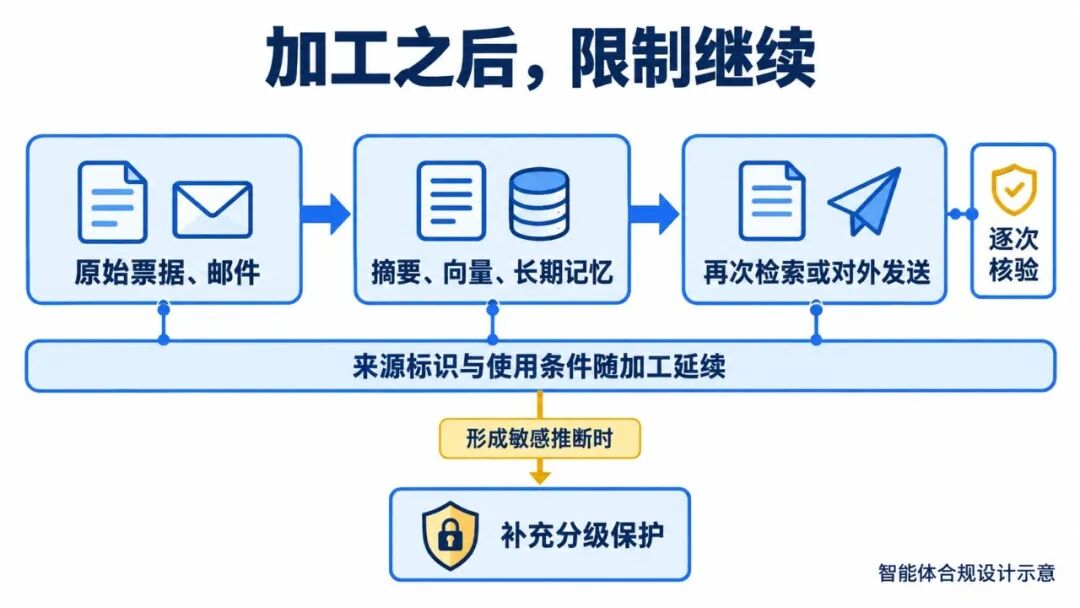
Diagram from the original post, in Chinese. DCC's English reading follows.
DCC’s English reading (illustration of agent compliance design). Original receipts and emails → summaries, vectors, long-term memory → retrieval or external sending, checked at each step. Underneath all three, provenance labels and use conditions carry over through processing. When a sensitive inference is formed, additional tiered protection is applied.
Adjusting or lifting restrictions on derived content, likewise, needs a clear basis and separate authority. Only when a data transformation genuinely meets predetermined conditions for de-identification, anonymization, or aggregation and de-sensitization may the system reclassify it on that basis. What reclassified data may then be used for, and to whom it may go, must still be set by the applicable rules. That is why Meta puts “reclassification” under a dedicated governance process, so label changes are independently constrained. In an agent setting, the point is just as simple: an agent writing “the above has been anonymized” into its own context can never substitute for a compliance judgment at the system level.
IV. Delegation between agents must keep permissions and provenance
In more complex scenarios, a lead expense agent may hand receipt classification to a second agent and the check for missing materials to a third. Each delegation reduces the complexity any one agent handles, but it also lengthens the chain along which personal information flows. If, at handover, the downstream agent receives only a natural-language instruction (“please process these materials”), the processing purpose, scope of subjects, and recipient restrictions fixed for the original task are easily lost along the way.
Delegation between agents therefore has to pass two kinds of information downstream together. One says what the downstream agent is allowed to do in this subtask. The other says where the materials it receives came from and what restrictions already attach to them. Concretely, the processing scope a sub-agent actually obtains in a given task should be bounded by three things together: the permissions the upstream agent may delegate, the sub-agent’s own system permissions, and what the current subtask actually needs. Even if a sub-agent is configured to access a broader database, the upstream agent cannot use delegation to borrow those higher permissions and widen the current task’s processing scope.
Beyond the permission boundary, continuity of provenance matters just as much. A preprint released in October 2026, Can CaMeLs Talk?, shows a typical cross-agent risk. Content the upstream agent treats as “untrusted external data”, once written into a natural-language task description sent to a downstream agent, is often executed by the downstream agent as a “trusted instruction” from upstream, so an attack can be relayed from agent to agent. The paper proposes containing this hidden “trust escalation” by separating the channels for control instructions and business data, and by preserving provenance continuously between agents.
For personal information protection, this security finding is directly instructive. Text from an invoice, an email, or a web page should keep its identity in the system as “task material” throughout. It must never, by being summarized or restated by an agent, turn into a “control instruction” with the authority to rewrite the task’s scope, name a new recipient, or direct that the data be used for something else. Only if every handover preserves the original processing conditions and provenance intact does the downstream agent have a basis for judging whether it may accept the materials, within what scope it may use them, and to whom it may pass them on.
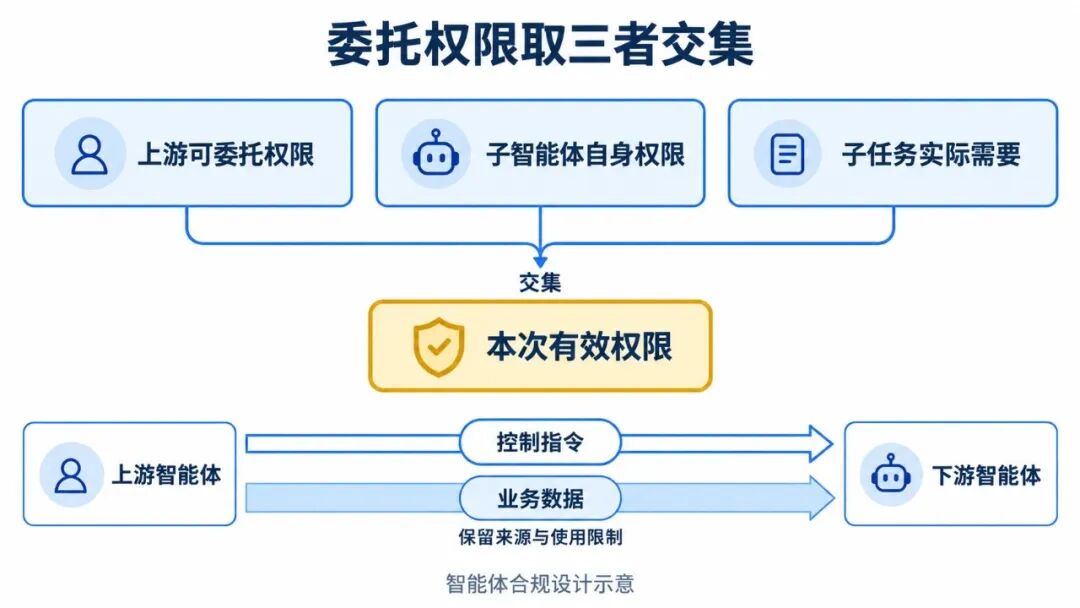
Diagram from the original post, in Chinese. DCC's English reading follows.
DCC’s English reading (illustration of agent compliance design). Upstream delegable permissions ∩ the sub-agent’s own permissions ∩ the subtask’s actual needs = the effective permissions for this delegation. Between the upstream and downstream agents, control instructions and business data travel on separate channels, and the business data keeps its provenance and use restrictions.
Going further, the delegation relationships in the technical architecture must also line up precisely with the relationships between processing parties in law. A cross-agent call may be a division of labor between two agent modules inside one company, or it may cross an organizational boundary and submit materials to another company’s model service. The law treats these completely differently. Articles 21 and 23 of the PIPL set the legal requirements for “entrusted processing” and for “providing personal information to another personal information handler” respectively. An agent platform’s tool catalog should therefore record, alongside each tool’s technical interface parameters and functional description, the organization behind the interface, its actual processing role, and the processing scope agreed by contract. Only then can the runtime chain of technical calls be translated into a clear, verifiable chain of legal responsibility.
V. Making the rules hold while the system runs
Whether data labels or call context keep working at runtime comes down, ultimately, to who makes the rules behind them, who may change them, and how changes reach every point of enforcement accurately. Automated technical enforcement is thus tied closely to organizational compliance governance. To make the rules hold while the system runs, four things matter most.
First, the definition of processing purposes and necessary scope needs substantive judgment behind it. A label-checking mechanism does not by itself produce reasonableness. Suppose the expense system always carries the “expense claim” label correctly, but the rule behind it allows reading all of the employee’s email, all their spending records, and even their family members’ information. Then however accurately the underlying mechanism works, it is only precisely enforcing a rule that is too broad. Building an agent system should therefore start from the substantive relationship between a specific business task and the data it needs, and produce a verifiable correspondence between business needs, legal assessment, and technical configuration. A blanket “the model might need it when reasoning” cannot stand in for a statement of necessity.
Second, system rules must change promptly as the task progresses and as individuals’ rights change. In its engineering, PrivacyLib uses caching and per-service deployment to reduce runtime cost and contain the impact of rule changes. When the mechanism is used for personal information protection, policy versions, deployment scope, and cache invalidation have to be managed too, so that every later operation is decided under the rules currently in force. For example, once the task authorization a data read or external send relied on has ended, or the individual has lawfully withdrawn consent, the system may no longer rely on a past “allow” result based on that earlier authorization or consent.
Third, an agent’s long-term memory and data deletion need to be dealt with separately. Temporary processing needed to complete one expense claim is very different, in processing scope and retention period, from keeping the materials in long-term memory for future tasks. The system should record, at the underlying layer, the mapping between long-term memory, text summaries, and vector indexes and their original data sources. When the applicable deletion conditions are met, it can then locate and clear the relevant content precisely. Where laws or administrative regulations require retention, it should restrict further use accordingly and block later retrieval and calls at runtime. In short, “stopping further access” and “dealing with existing copies” each need their own technical actions.
Fourth, the runtime controls themselves have to be verifiable. To cut the cost of massive telemetry, Meta uses deduplication and sampling. That suits macro-level analysis of operating patterns and anomaly hunting. But for specific personal information processing that may need to be traced and attributed, the system should also keep the necessary authorization source, policy version, access target, data recipient, and final result in full. Audit records can of course use identity references and asset identifiers. There is no need to copy a full set of personal information into the logs just to prove the protection works.
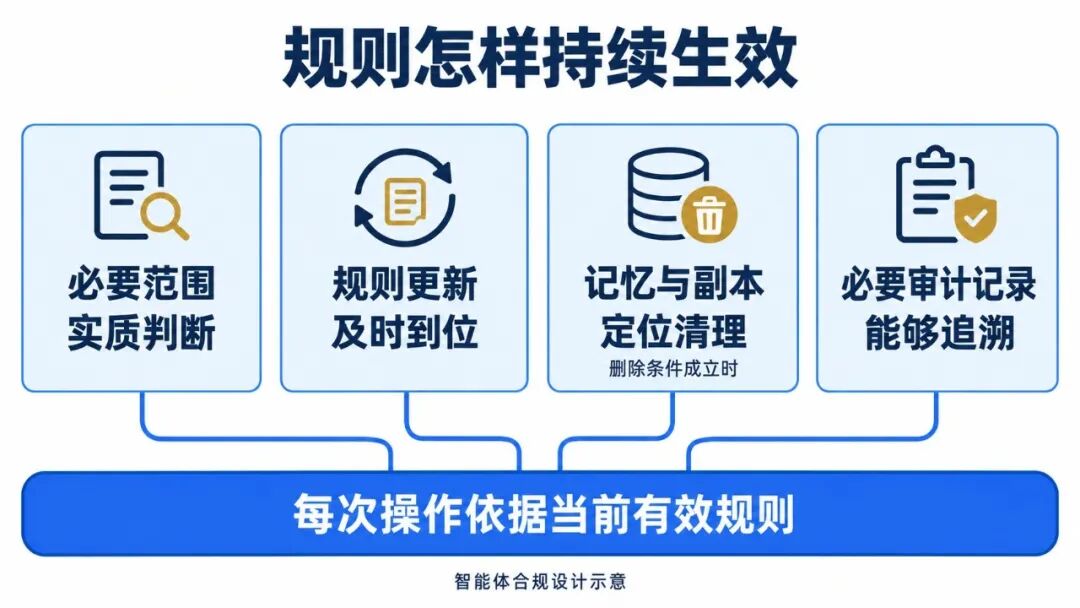
Diagram from the original post, in Chinese. DCC's English reading follows.
DCC’s English reading (illustration of agent compliance design). Four supports: substantive judgment of necessary scope; rule updates that arrive promptly; locating and clearing memory and copies when deletion conditions are met; necessary audit records that can be traced. Together they rest on one base: every operation follows the rules currently in force.
In the end, these requirements have to be carried out by each organization involved in the processing, according to its role. Who decides the purposes and means of processing, who provides entrusted processing services, and who actually controls the tools, the permissions, and the points where data flows should all be clearly defined in system design and in contracts. Only by turning the relevant compliance decisions into rules the system can enforce, block on, and trace can each party’s personal information protection obligations actually be performed while agents run dynamically.
Back to the expense claim. The autonomy users really want from an agent is for the system to choose steps and coordinate the task by itself, within reasonable limits. For that autonomy to be compatible with personal information protection, the boundaries of processing must stay tied to the specific processing purpose, the minimum necessary scope of data, and clear recipient conditions, and must carry through into data processing, memory retention, and delegation between agents.
Meta’s PrivacyLib pushes continuous runtime verification down into the underlying data-access infrastructure. Extending rule checks along the same lines to derived content, long-term memory, and chains of agent delegation gives personal information protection in the age of agents an enforcement path that runs through the whole task. A task can unfold dynamically, but processing authority must not expand by itself as data is read, generated, saved, and handed on. Only when every concrete operation is decided under the rules in force at that moment, and every flow of information fully carries the protective restrictions that apply to it, can the organizations involved really meet their personal information protection obligations in complex, shifting systems.
— 网安寻路人, 智能体处理个人信息的边界如何持续有效——从 Meta PrivacyLib 看个人信息保护的运行机制 (How Can the Boundaries of an AI Agent’s Personal Information Processing Stay Effective? Personal Information Protection at Runtime, Seen Through Meta’s PrivacyLib), October 28, 2026. Original (Chinese).
— Not legal advice.